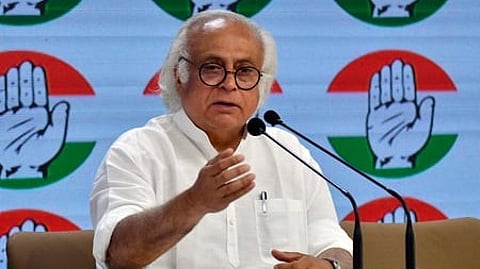

The Congress on Wednesday dismissed the GST Council’s recent rate cuts as a partial fix and termed it a "GST 1.5".
Responding to the overhaul of the Goods and Services Tax (GST) regime announced on Wednesday, Congress general secretary in-charge communications Jairam Ramesh reiterated that the wait for a full-fledged “GST 2.0” still continues.
The opposition leader also criticised the workflow where Prime Minister Narendra Modi had already outlined key GST reforms in his August 15 Independence Day address, even before the official GST Council meeting. Ramesh questioned whether the Council was being reduced to a mere formality.
He said that a key demand of the states made in the true spirit of cooperative federalism — namely, the extension of compensation for another five years to fully protect their revenues — remains unaddressed. In fact, that demand assumes even greater importance now, he said.
"The Congress has for long been advocating for a GST 2.0 that reduces the number of rates, cuts the rates on a large number of items of mass consumption, minimises evasion, mis-classification, and disputes, does away with inverted duty structure (lower tax on output as compared to inputs), eases the compliance burden on MSMEs, and expands GST coverage," Ramesh posted on X.
He noted that Union Finance Minister Nirmala Sitharaman has made major announcements last evening after the meeting of the GST Council, which is a constitutional body.
“However, even before the GST Council meeting, the Prime Minister had already proclaimed the substance of its decisions in his Independence Day speech of August 15th, 2025. Is the GST Council to be reduced to a formality?” Ramesh said.
He also said that the Congress had already highlighted the GST flaws in 2017.
“Faced with a lack of buoyancy in private consumption, subdued rates of private investment, and endless classification disputes, the Union Finance Minister has finally recognised that GST 1.0 had reached a dead end. In fact, the very design of GST 1.0 was flawed and this had been pointed out by the INC (Indian National Congress) way back in July 2017 itself, when the PM had made one of his typical U turns and decided to introduce GST,” Ramesh's post on X also read.
It was meant to be a ‘Good and Simple Tax’ but turned out to be a ‘Growth Suppressing Tax’, Ramesh said.
The Congress functionary further said that Wednesday evening's announcements have certainly made headlines since the prime minister had already laid down the pre-Diwali deadlines. Presumably the benefits of rate cuts will be passed on to consumers, he added.
"However, the wait for a true GST 2.0 continues. Whether this new GST 1.5, if it can be called that, stimulates private investment — especially in manufacturing — remains to be seen. Whether this will ease the burden on MSMEs, time alone will tell," Ramesh said.