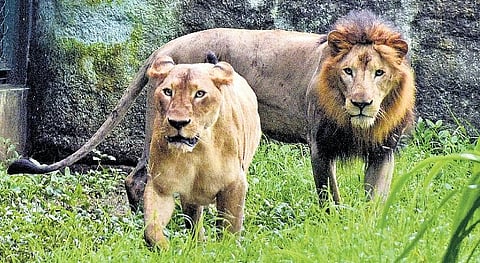

AHMEDABAD: The Gujarat government admitted in the Assembly on Wednesday that 307 Asiatic lions, have died in just two years, despite spending Rs 37.35 crore to prevent unnatural deaths.
The disclosure raises serious questions about conservation strategies, as the lion population now stands at 891, spread across seven districts.
The deaths, driven by disease, internal fights, and accidents, reveal a grim battle for survival inside the Gir ecosystem and surrounding areas.
Gujarat is the only home to Asiatic lions in the world, but behind the celebratory headlines of a rising lion population, a silent tragedy is unfolding.
The 16th Asiatic Lion Census, conducted on May 13, 2025, counted 891 lions spread across seven districts, with the highest concentration in Amreli (339), followed by Gir-Somnath (222), Junagadh (191), Bhavnagar (116), Porbandar (16), Rajkot (6), and Devbhoomi Dwarka (1).
These numbers, while impressive on paper, mask a disturbing reality: 307 lions have died in the last two years, revealing cracks in Gujarat’s much-touted conservation model.
According to Government Data, between August 2023 and July 2024, the state lost 141 lions, a toll already alarming for a critically endangered species.
Yet, instead of improving, the situation worsened. From August 2024 to July 2025, the death count spiked to 166, pushing the two-year total to a staggering 307 lions lost, a figure that threatens to undo decades of conservation efforts.
While most deaths were classified as natural, many were preventable, exposing failures in disease control, veterinary care, and basic habitat safety.
The year 2023-24 set the stage for this unfolding crisis, with disease emerging as the single largest killer, claiming 60 lives.
Shrinking habitats forced lions into closer contact, leading to 38 deaths from violent territorial fights, while another 24 perished from old age.
Human-linked threats also played a deadly role; seven lions fell into open wells, five were struck by trains, three drowned, and one each died in a road accident and by electrocution.
By the end of that year, the total death toll stood at 141, painting a bleak picture of a fragile ecosystem under pressure.
But the following year, 2024-25, the situation turned even grimmer. Illness-related deaths surged to 81, a 35% jump, highlighting growing gaps in disease monitoring and treatment.
Internal fights remained a serious problem, killing 36 lions, while 27 succumbed to old age.
Open wells turned deadlier, with 13 lions plunging to their deaths, while six drowned, two died from electric shocks, and one was hit by a vehicle. The result was 166 deaths in a single year, the highest in recent memory and a wake-up call for the state’s conservation machinery.
The crisis is most visible in Amreli district, which, despite housing the largest lion population, has also become a graveyard for the species.
Between January and July 2025 alone, 31 lions including 14 cubs and 17 lions, died, most of them from illnesses that could have been treated with timely intervention.
Multiple organ failure claimed five cubs and six lions, while pneumonia, anaemia, and anoxia took five more lives. Pneumonia and septicemia together killed four lions, while respiratory, liver, and kidney failures accounted for six additional deaths, including two cubs.
A fatal spinal cord injury ended the life of one cub, and a parasitic disease, anaplasmosis, claimed another four lives. These patterns reveal systemic weaknesses in veterinary care and health monitoring, with infections and preventable diseases spreading unchecked.
Even as deaths mounted, the Gujarat government insists it has been pouring resources into conservation.
Over the past two years, it spent Rs 20.35 crore in 2023-24 and another Rs 17 crore in 2024-25, totalling Rs 37.35 crore. However, the rising death toll tells a different story.
Despite massive financial outlays, lions continue to die from basic, preventable causes such as open well accidents, poor disease management, and lack of emergency infrastructure, raising serious questions about accountability and effectiveness.
This crisis matters not just for Gujarat but for the entire world.
Asiatic lions are critically endangered, and Gujarat is their only natural habitat on Earth.
While the census figures may create an illusion of stability, the sharp rise in deaths suggests a dangerous tipping point. If disease control, veterinary systems, and habitat safety measures are not urgently overhauled, Gujarat’s celebrated success story could collapse into a silent tragedy.