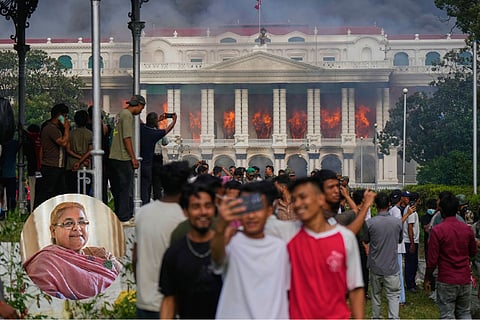

Former Chief Justice Sushila Karki has emerged as the preferred choice of Nepal’s Gen Z-led protest movement as the country's interim leader following days of deadly unrest that left at least 25 people dead and hundreds injured, prompting the resignation of Prime Minister Khadga Prasad Oli.
Soldiers in Kathmandu were ordered to enforce curfew-like conditions Wednesday after the military mobilized overnight to quell two days of chaos. Protesters had torched government buildings, the parliament, the presidential house, and the prime minister’s office. Armed troops checked vehicles, instructed residents to remain home, and restored a measure of order after police failed to contain the demonstrations. The Nepal Army also quelled a jailbreak in central Kathmandu, apprehending inmates who had overpowered guards and attempted to escape, with no injuries reported, according to the Health Ministry.
Protests erupt over social media ban and broader grievances
The unrest began Monday after the government briefly banned major social media platforms, including Facebook, X, and YouTube, citing non-compliance with new registration and oversight requirements. Although the ban was lifted on Tuesday, protests continued, fueled by outrage over police firing on demonstrators, which contributed to the initial deaths. The unrest has since claimed six more lives, bringing the death toll to 25, with 633 injured.
Dubbed the “Gen Z protest,” the movement reflects broader frustration among young Nepalis over corruption, political stagnation, and entrenched elites. Protesters have targeted leaders and institutions perceived as benefiting from nepotism, including the children of political figures, locally known as “nepo kids.” Videos circulating on social media showed attacks on Nepali Congress party leader Sher Bahadur Deuba and his wife, Foreign Minister Arzu Rana Deuba. Vehicles and commercial properties, including the offices of Kantipur, Nepal’s largest media outlet, were set on fire.
Youth unemployment remains a major driver of anger. According to the World Bank, nearly 20% of young Nepalis were unemployed last year, while the government estimates that over 2,000 youth leave the country daily for work in the Middle East or Southeast Asia.
Karki: a neutral and respected choice
Representatives of the protesters met military officials at the Army headquarters in Kathmandu to discuss a transitional leadership plan, with some pushing for former Chief Justice Sushila Karki. Born in Biratnagar, Karki holds degrees in political science and law from Mahendra Morang Campus and Banaras Hindu University. She began her legal career in 1979 and rose to become Nepal’s first woman Chief Justice in 2016.
During her tenure, Karki earned a reputation for integrity and independence, taking bold steps against corruption and nepotism. She curtailed the powers of the anti-graft chief Lokman Singh Karki and ordered the imprisonment of former minister Jaya Prakash Prasad Gupta. In 2017, an attempt by lawmakers to impeach her collapsed after strong public opposition, solidifying her image as an incorruptible outsider, according to The Kathmandu Post.
Following her nomination by the Gen Z protest movement, Karki indicated her readiness to accept responsibility. She emphasized that her priority would be to restore peace, address humanitarian and economic consequences of the unrest, and oversee fresh elections within six to twelve months. She stressed her intent to lead only a transitional government and hand over authority to elected representatives once stability is restored, Nepal News reported.
However, not all protesters support her appointment; some representatives of the crowds gathered outside the Army headquarters opposed the choice, reflecting internal divisions within the movement.
Political vacuum and transitional governance
The protests led to Prime Minister Oli’s resignation on Tuesday. President Ram Chandra Poudel asked him to lead a transitional government temporarily, but Oli reportedly fled his official residence, leaving his whereabouts unclear. The Nepal Army, rarely mobilized in the country, stepped in after police failed to control the unrest, signaling the severity of the crisis.
If Karki assumes the interim leadership role, her first steps would likely involve consultations with Army Chief General Ashok Raj Sigdel, followed by formal approval from the President, Setopati reported. Other youth-backed figures, such as Kathmandu Mayor Balen Shah, remain popular but have not publicly committed to political leadership, according to Reuters. Meanwhile, Dharan Mayor Harka Sampang has engaged in preliminary discussions with the Army, signaling ongoing negotiation within the youth movement, Setopati added.
Later on Wednesday, Balen Shah announced his support for Karki to lead an interim government.
Analysts cited by Reuters and Setopati suggest Karki’s selection reflects deep distrust of mainstream political parties among Nepal’s youth. Her reputation as a competent, independent, and incorruptible figure resonates with Gen Z protesters at a moment when Nepal’s fragile democracy faces its biggest test since the abolition of the monarchy in 2008.
Social media regulation and freedom of expression
The unrest unfolded against the backdrop of Nepal’s broader attempt to regulate social media. A proposed bill requires major platforms to appoint a liaison office in the country, a move criticized by rights groups as a potential tool for censorship and suppression of dissent. Platforms that did not comply were briefly blocked, though TikTok, Viber, and several others remained operational.
Historical and symbolic significance
Karki’s nomination carries historic significance. As Nepal’s first female Chief Justice, she embodies gender inclusivity and independent leadership. Her selection by young Nepalis signals a generational shift, reflecting growing demand for leaders untainted by party politics and committed to accountability and reform.
While the Army has restored a fragile calm, the broader struggle against corruption, generational frustration, and political stagnation remains unresolved. Karki’s potential interim leadership is seen as a critical step to stabilize Nepal, implement reforms, and rebuild public trust in the country’s democracy.