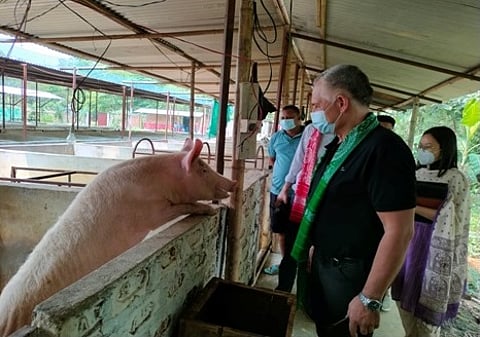

GUWAHATI: In Assam’s Bodoland Territorial Region (BTR), where pork is a delicacy, the government is aiming at self-sufficiency with the British breed of domestic pigs called Large White Yorkshire (LWY).
Under the Bodoland Pig Mission launched in 2021, the BTR government is collaborating with the Netherlands-based Programma Uitzending Managers (PUM) and the Danish Consortium of Academic Craftsmanship (DCAC) of Denmark.
Pork is the most consumed meat in BTR, yet the demand-supply gap forced the region to import pigs, often at a higher cost and with risks of disease transmission.
According to officials, BTR consumes over 25,000 metric tonnes of pork annually, but local production accounts for less than 40 per cent of the demand. The Mission seeks to close this gap by boosting domestic production and focusing on promoting scientific pig rearing, establishing modern breeding and fattening units, and developing a complete value chain around the pork industry.
Pushpadhar Das, an Officer on Special Duty, told this newspaper that the BTR government would bring 260 LWY pigs – 250 females and 10 boars – from the Netherlands.
“We don’t get a pure breed here, so we are bringing the LWY pigs for breeding. We are expecting their arrival in January next year. Our farm at Baksa is under construction. The work should be over in the next two to three months,” Das said.
Under the mission, 115 breeders have been trained. Piglets born at the farms of the breeders will be distributed among the pig farmers.
“We will also bring semen and try artificial insemination. The only problem is about storing it, so we have decided to bring it at regular intervals till the breeding farms have a sufficient number of breeding stock,” Das explained.
As inbreeding is a big problem among pigs, authorities have decided to maintain a database of the pigs, which will undergo artificial insemination, as well as their offspring.
Das said the collaboration with DCAC would take effect in the next phase following breeding. It will be mostly on knowledge sharing on the pork value chain.
“We sent a team to Denmark in 2023 and signed an agreement with DCAC. They will visit us and share their knowledge, and we will also send our farmers to Denmark for training. They will help us in adding value to pork and guide us about slaughterhouse design, cold chain maintenance, breeding, etc,” Das said.
He also said that the BTR would need six to seven years to achieve the goal of producing 1 lakh kgs of pork daily.
“African swine fever is a problem but, luckily, it has not affected the farms of farmers we are nurturing in the BTR’s core areas. The reason is we are maintaining biosecurity,” Das said.
He said the government was promoting bigger community-based farms, aiming at having 300 to 1,000 fattened pigs. Within six months of birth, an LWY pig weighs around 100 kgs, if proper scientific management is adopted, he added.
“We are trying to move away from backyard farming by aiming at bigger farms. The reason is that the measure for biosecurity is the same irrespective of the size of farms. The farmers also must have knowledge of good animal husbandry practices,” he said.