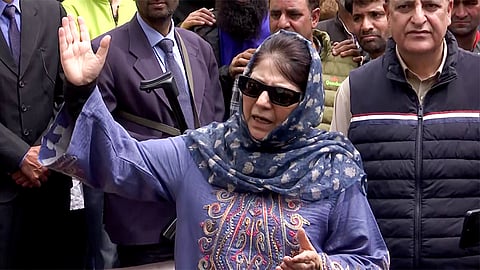

SRINAGAR: Former Jammu and Kashmir Chief Minister and PDP president Mehbooba Mufti has written to Union Home Minister Amit Shah, urging him to review the case of detained JKLF chief Yasin Malik, who has been awarded a life sentence by an NIA court, through a humanitarian lens.
She said, “one cannot ignore the courage it took him to renounce violence and choose the path of political engagement and non-violent dissent.”
“I write to you not merely as a witness but as someone who has lived through the turbulent times of Jammu and Kashmir, bearing its grief, enduring its silences, and holding on to its fragile hopes,” Mehbooba writes in her letter to Shah.
“This letter is written not in defiance but in faith, faith in the promise of reconciliation and in the belief that this great nation, even in its most challenging moments, can still choose healing over hurt.”
Mehbooba appealed to the Home Minister for a compassionate and urgent review of the case of Yasin Malik, a name that once symbolised resistance, later chose restraint and now remains silenced behind prison walls.
Yasin Malik was detained before the abrogation of Article 370 on charges of terror funding and is currently lodged in Delhi’s Tihar Jail. In 2020, a National Investigation Agency (NIA) court awarded a life sentence to him for terror funding and conspiring to wage war against India.
“Yasin Malik’s journey is no secret to the Indian State. In 1994, he took a courageous and rare decision to lay down arms and embrace political, non-violent means to pursue change,” the PDP chief said.
Mehbooba added that, as per Malik’s sworn affidavits, this shift was neither unilateral nor impulsive but encouraged and facilitated through back-channel understandings with Indian agencies.
“Over the years, Malik engaged in dialogues involving senior officials, intelligence personnel, and controversial figures like Hafiz Saeed, all with the tacit consent of Indian agencies. These efforts represented a painstaking and deliberate attempt to build bridges in a deeply fractured land.”
For years, she said, Malik participated in talks, travelled with official clearance, and was regarded – even if reluctantly – as a crucial bridge between estranged realities.
“He was granted bail in all 32 pending TADA cases, none of which the government pursued. As per Malik this truce was honoured for 25 years across the tenures of Narasimha Rao, Vajpayee, Gujral, Manmohan Singh, and even Modi’s first term. But everything changed after August 2019. Old cases were resurrected, JKLF was banned, and the man once seen as a potential peace interlocutor was recast as a terrorist, sentenced to life imprisonment, and now potentially facing the death penalty.”
Stressing that the world is rapidly changing and hostility appears to be triggering a reset in global politics, the former CM said, “Visionary leaders like Atal Bihari Vajpayee and Dr. Manmohan Singh understood and pursued with quiet conviction that our country’s enduring strength flows from dialogue, not domination."
"Trust in the people of Jammu and Kashmir is fundamental. Unfortunately, we Kashmiris remain marginalised, our voices excluded from decisions that shape our lives," she said.
"This must change if durable peace and a secure environment for democracy, development, and growth in Jammu and Kashmir, and indeed the region and country, are to be realised. Brute force must give way to the healing touch of dialogue, and constitutional rights must be restored,” she added.
“In light of Yasin Malik’s long-standing commitment to non-violence, the urgent need for reconciliation, and humanitarian dimensions of this case, I implore your office to consider a compassionate reassessment. This appeal does not seek to undermine the judiciary’s authority but calls for the responsible exercise of democratic instruments to honour both justice and mercy. The spirit of India, I firmly believe, lies in our capacity to show magnanimity and uphold promises made in pursuit of peace,” Mehbooba said.
Urging the Home Minister to initiate a compassionate and considered review of Yasin Malik’s case, she said closing the door forever on a man who once chose peace risks shattering the fragile trust essential for meaningful dialogue.
“If that trust breaks irreparably, every Kashmiri feeling disillusioned and abandoned will withdraw from engaging with the Indian government towards the larger vision of peace and reconciliation. Such an outcome would perpetuate the cycle of conflict and alienation and extinguish hope for healing this fractured land for generations to come,” she added.