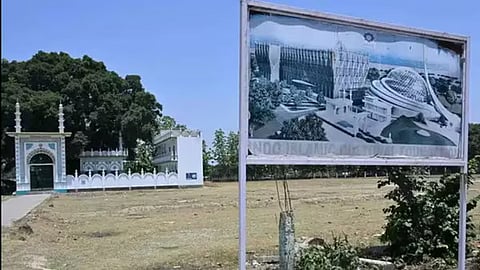

LUCKNOW: The Indo-Islamic Cultural Foundation — the trust overseeing the construction of the proposed mosque in Ayodhya — is considering submitting a new design inspired by the local architectural style. Instead of a glass façade and other modern decorative elements, the mosque will now be designed in alignment with local sentiments and traditional aesthetics.
As the decision to revise the design was made last year, the trust did not follow up with the local development authority to get the original building plans approved.
The day-to-day functioning of the Indo-Islamic Cultural Foundation, the trust pursuing the construction of the mosque, is managed by a group of eight life trustees with Zufar Ahmad Faruqi as its Chairman and Athar Husain as Secretary.
Faruqi is also the Chairman of the UP Sunni Central Waqf Board.
The trust has six more members, including vice-president Adnan Farrukh Shah, a prominent cleric from Gorakhpur, treasurer Faiz Aftab, a Meerut-based businessman, and Mohd Rasheed, Imran Ahmed, Zunaid Siddiqui, and Saud Uz Zaman as members. Rasheed, Ahmed, and Siddiqui are businessmen from Lucknow, while Zaman is from Banda.
In addition to the life trustees, several other individuals are associated with the trust in various capacities, contributing insights and participating in different committees.
According to Secretary Athar Husain, suggestions for modifying the mosque’s design came from people in touch with the trust's chairman who had expressed interest in supporting the project.
“Hence, we are preparing a new blueprint with the help of industry experts and will resubmit our application. There's no need to dwell on the previously rejected proposal,” he said.
He further added, “On behalf of the trust, we would also request the state government to provide a wider access road to the mosque site at Dhannipur in Sohawal.”
While the previous design took inspiration from Gulf-style mosques, trust officials stated that the revised version will adhere to architectural principles rooted in the Awadh region. The new structure will be built using brick, mortar, and other locally relevant materials.
The trust was allotted five acres for the construction of the mosque. Husain reiterated that a significant portion of this land will be used to establish a museum dedicated to Ahmadullah Shah, a maulvi from Faizabad who fought against the British during the 1857 uprising.
