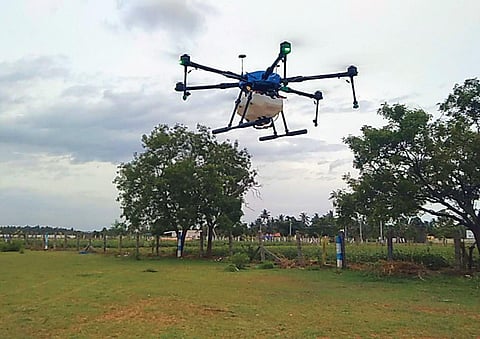

NEW DELHI: The Border Security Force (BSF) with the help of the Indian Space Research Organisation (ISRO) is developing drone mounted radar systems, which will be used by troopers for surveillance along India’s western and eastern frontiers without crossing the borders, officials said on Sunday.
They said that the ISRO would assist the BSF in developing drone-based radars, as it is considering fitting small radars onto drones, which would be crucial for border surveillance and understanding enemy movements.
The officials also confirmed that the system is developed. The BSF, which is known as India’s first line of defence, will manufacture the sensitive equipment on its own at at its Tekanpur Academy situated in Madhya Pradesh.
A senior BSF officer told this newspaper that the experience, which the force gathered during ‘Operation Sindoor’, led us to understand the role of drones in future warfare and keeping this in view we have set up a School of Drone Warfare at the BSF Tekanpur Academy”.
“The BSF has been in talks with the ISRO. Now, the ISRO will assist the force in developing drone-based radars. The BSF is also considering fitting small radars onto drones, which would be crucial for border surveillance and understanding enemy movements. In the coming few months, BSF will also start manufacturing radar-equipped drones on its own,” the officer said.
He said that the drone-based radar systems could enhance the security along the India-Pakistan and India-Bangladesh borders, as the current physical guarding of the borders is effective only over limited areas, while drone-mounted radars can monitor remote and difficult terrain.
“Their biggest advantage is that they operate day and night and in all weather conditions, whether foggy, dark or rainy. Radar-equipped drones can quickly detect the movement of moving targets, small vehicles, or intruders. This provides the BSF with real-time alerts, allowing the forces to act quickly,” the officer said.
The drone mounted radar system would also enable the troops to conduct surveillance in areas, where setting up permanent radar or outposts are difficult, he said, adding that this would also help in controlling attempts of smuggling or supplying weapons from across the border.
Securing borders in the present time has no longer been limited to mobile soldiers or fixed towers, technological interventions can significantly enhance surveillance and response capabilities.
Vigilance on borders to get tech boost
Enhance daily vigilance: Continuous coverage of wide areas – especially difficult terrain and remote sections
Surveillance in night and during bad weather: Radar can track even when visual sensors are not working
Fast-track alerts/triggers: Helps deploy forces quickly as it gives real-time alerts
Integrated sensor fusion: Combining radar, infrared, high-resolution cameras and ground sensors can provide better detection
Mobility and Scalability: Deployment in small areas – In times of crisis, deploying more drones to provide increased coverage
