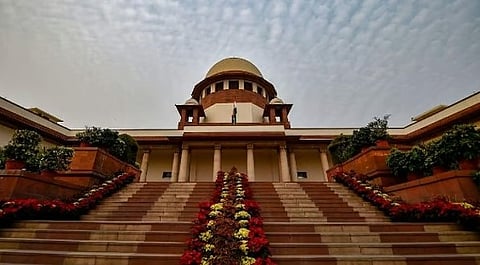

NEW DELHI: National Council for Transgender Persons (NCTP) Chairperson Laxmi Narayan Tripathi and member Zainab Patel have and filed a petition in the Supreme Court challenging the Constitutional validity of the Transgender Persons (Protection of Rights) Amendment Act, 2026 which introduced many changes to the legal framework governing the recognition, rights and protection of transgender persons.
The amendment was passed by the Parliament recently, taking away the right to self-determination of gender, the plea claimed.
The law had received presidential assent recently on March 31.
The petition filed by Tripathi and Patel, is expected to come up for hearing within a week in the top court, a senior official from the Supreme Court registry told TNIE. "Keeping in view the sensitivity of the case, the plea will likely to come up for hearing in a week or so," he said.
It is to be noted that the controversial law amends the Transgender Persons (Protection of Rights) Act, 2019. It redefines who qualifies as a “transgender person,” while also strengthening penal provisions to address serious offences such as forced identity and bodily harm.
The petition challenged the Amendment Act, as causing "irreparable constitutional injury" to the fundamental rights of transgender persons guaranteed under Articles 14, 15, 19 and 21 of the Constitution.
The plea raised certain constitutional question, as to whether the State, through legislation, can define who a person is by substituting biological or socio-medical classifications for a person's lived and self-perceived identity.
"The amendments dismantle the principle of self-identification of gender recognised as a fundamental right by the Supreme Court in the landmark National Legal Services Authority (NALSA) v. Union of India judgment. The petitioners submit that the Court is now called upon to protect a right that it had previously declared to be intrinsic to dignity and personal autonomy under Article 21," the plea stated.
It further submitted that the Parliament has, by the stroke of a legislative pen, repealed the statutory right that this Court held to be a fundamental right under Article 21. "The impugned deletion does not even require elaborate constitutional analysis to expose its unconstitutionality: a provision that directly codifies a right declared fundamental by this Court cannot be omitted by ordinary legislation without violating Article 21 and the doctrine of non-retrogression of fundamental rights," the plea says.
After the new legislation was made, it was being severely criticised by pposition parties and LGBTQIA+ (Lesbian, Gay, Bisexual, Transgender, Queer, Intersex and Agender etc) communities.
Those who opposed the legislation have argued that they were not consulted at all prior to the introduction of the Bill in parliament. Two members of the NCTP, Kalki Subramanium and Rituparna Neog, resigned from their posts the day the Rajya Sabha passed the Bill.
