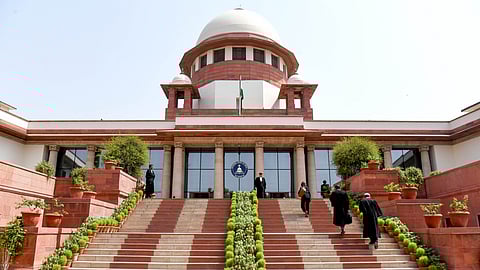

The Supreme Court of India on Thursday observed that Hinduism could be adversely affected and society may become divided if temples and “mutts” restrict entry based on sects or denominations within the religion.
The observation was made by a nine-judge Constitution bench headed by Chief Justice Surya Kant while hearing submissions by senior advocate C S Vaidyanathan. He argued that Article 26(b) of the Constitution grants religious denominations the right to manage their own affairs and should prevail over Article 25(2)(b), which allows the State to open Hindu religious institutions of a public nature to all sections.
Vaidyanathan was appearing for devotees of Lord Ayyappa of the historic Sabarimala temple in Kerala.
The bench, also comprising Justices B V Nagarathna, M M Sundresh, Ahsanuddin Amanullah, Aravind Kumar, Augustine George Masih, Prasanna B Varale, R Mahadevan, and Joymalya Bagchi, is hearing petitions concerning alleged discrimination against women at religious places, including Sabarimala, and examining the scope of religious freedom across faiths.
Vaidyanathan, representing the Nair Service Society and other organisations related to the devotees of Lord Ayyappa, vehemently put forth the point that they constitute a separate religious denomination and consequently, have the right to manage the affairs of the hilltop temple.
He submitted that a denominational temple can give permissive rights and have worship or confine it only to the denomination.
To this, Justice Nagarathna said, "There is one apprehension. If you say the right of entry, in the context of (the) Venkataramana Devaru (judgment of the apex court), where they said anybody other than Gowda Saraswat Brahmins is excluded, it will negatively affect Hinduism."
She added, "Everybody must have access to every temple and mutt. Keep aside the controversy in the Sabarimala judgment (2018). But if you say it is a practice and it is a matter of religion that I will exclude others and only my section, my denomination, will attend the temple and nobody else, that is not good for Hinduism. Let the religion not be adversely affected. It will be counter-productive for the denomination."
Concurring with the view, Justice Kumar said such exclusions will divide the society.
Vaidyanathan said in reality, there are private family temples in Kerala where only the members of these families go and these temples serve only their denomination, they cannot seek funds either from the state or private donors or from the public because they are not dependent on them.
If a law is to be made, it has to pass the test of public order, morality or health, he asserted.
Justice Nagarathna said she was not referring to such private temples and regardless of the question the Devaru judgment decided, "Let the religion not be adversely affected."
She told Vaidyanathan to keep aside the Sabarimala controversy and emphasised that if the argument is that only Gowda Saraswat Brahmins must come to a temple, the followers of the Kanchi Mutt must only go to Kanchi, they should not go to Sringeri, the followers of Sringeri must not go to Kanchi, then it will affect the religion".
Vaidyanathan said it was a reality and it was for each denomination to think about that.
Justice Nagarathna said the State can step in under Article 25(2)(b) to ensure access to temples to all sections of the society.
Justice Kumar also told Vaidyanathan, "That is why we said, do not pitch the argument too high," referring to his contention that Article 26(b) supersedes Article 25(2)(b).
Vaidyanathan argued that holding that Article 25(2)(b) will prevail over Article 26(b) will uniquely affect the Hindu religion only, since Article 25(2)(b) allows the State to make laws only to make Hindu temples open to all sections of the society.
He agreed that public temples must be open to all, but added that the same cannot be insisted for denominational temples.
In the Devaru judgment (1957), the top court had upheld the Madras Temple Entry Authorisation Act, affirming that while a temple remains open to all Hindus, certain ceremonial practices reserved for the Gowda Saraswath Brahmins are constitutionally permissible.
During the hearing, Vaidyanathan submitted that an individual's freedom of conscience defeats the freedom of the community or denomination.
Justice Kumar asked him whether he agrees that Article 26 is not an island provision or a standalone article and whether he agrees with the view of the Union government that the provision has to be read with Article 25(2).
Vaidyanathan said he is in disagreement with the Centre's submission as Article 25(2) is an enabling power and does not confer any right, while Article 26 confers a specific right to a denomination.
He submitted that in the 2018 Sabarimala verdict, Justice (retired) D Y Chandrachud had asked a wrong question and got a wrong answer.
"He asked whether individual rights would prevail over group or collective rights and he held wrongly that individual rights can prevail over collective religious rights," he submitted.
"In Sabarimala, there is no distinction made between devotees. There is no bar to Christians or Muslims even, but they must have faith and belief in the divinity of Lord Ayyappa and they have to follow rituals like the 40-day Vratam and whatever practices enjoined on the believers. Nobody is prohibited and therefore, this concept has not been understood."
The hearing would resume next week.
(WIth inputs from PTI)
