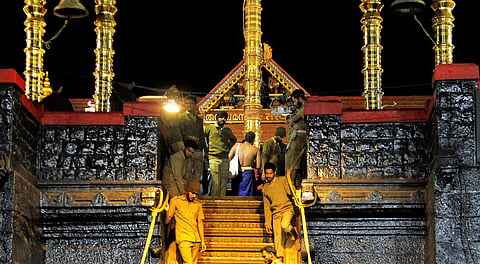

NEW DELHI: The Supreme Court’s nine-judge Constitution Bench on Tuesday began hearing a batch of review petitions related to the entry of women into the Sabarimala temple.
The Court will examine the scope of Articles 25 and 26, the essential religious practices doctrine, and the extent of judicial review in matters of faith.
The nine-judge Constitution Bench of the apex court, headed by Chief Justice of India (CJI) Surya Kant, along with Justices B V Nagarathna, M M Sundresh, Ahsanuddin Amanullah, Aravind Kumar, Augustine George Masih, Prasanna B Varale, R Mahadevan, and Joymalya Bagchi, is hearing the batch of review petitions in the Sabarimala matter.
Ahead of the crucial hearing on Tuesday, the Centre filed written submissions requesting the top court to uphold the restriction on the entry of women of menstruating age into the Sabarimala temple.
“The issue falls squarely within the domain of religious faith and denominational autonomy, and lies beyond the scope of judicial review,” it told the Court. Solicitor General Tushar Mehta is appearing for the Centre.
In its previous hearing, the apex court had, on February 16, stated that the review petitioners would be heard from April 7 to 9, 2026.
“The nine-judge bench shall begin hearing the review case on April 7, 2026, at 10:30 am. The review petitioners shall be heard from April 7 to 9, 2026. The parties opposing the review will be heard from April 16 to 17, 2026. Rejoinder submissions will be heard on April 21. The parties must adhere to the schedule,” a three-judge bench led by CJI Kant had said.
The review petitions, which are pending before the Court, challenge the 2018 verdict that held the traditional ban on women aged 10–50 entering the Sabarimala temple to be unconstitutional.
In March this year, the state’s Left Front government modified its earlier position favouring women’s entry to Sabarimala ahead of the Assembly elections.
In its affidavit submitted to the Supreme Court, the government stopped short of explicitly supporting or opposing women’s entry.
In response to the Court’s queries, the government referred to its 2007 affidavit and stated that the opinions of social reformers and religious scholars should be considered in arriving at a decision.
Referring to the backlash and protests following the earlier decision, it noted that “previous experience in the matter of the Sabarimala shrine and the responses of devotees, including women, would support” its position.
On the scope and extent of judicial review in matters of religious practice, the state submitted, “Any judicial review of a religious practice followed for many years and connected with beliefs and values accepted by the people must be undertaken after wide consultation with eminent religious scholars and reputed social reformers of that religion.”
The government adopted a neutral stance, considering the political sensitivity of the issue ahead of elections, and chose not to directly support or oppose women’s entry.
Addressing whether a person outside a religious denomination can challenge its practices through a PIL, the state said that ordinarily there is no reason for outsiders to intervene.
However, in cases involving grave human rights violations, such challenges may be justified.
“The essentiality of a religious practice must primarily be tested with reference to the tenets of that religion. In determining whether a practice is integral, the test should be whether it is regarded as such by the community following the religion,” the affidavit stated.
The state also noted that Article 25(2)(b) allows the state to enact laws for social reform and to open Hindu religious institutions of a public character to all sections of Hindus, including denominational institutions.
More than 50 review petitions filed by devotees, religious groups, individuals, and organisations argue that the Court should not interfere with essential religious practices, asserting that Lord Ayyappa devotees constitute a separate religious denomination.
These petitions form part of a broader set of cases concerning alleged discrimination against women in religious practices, including entry into places of worship. The Centre has supported the review petitioners.
“The Centre will argue in support of the review petitioners,” Solicitor General Tushar Mehta had earlier informed the bench.
The 2018 verdict, delivered by a 4:1 majority, lifted the ban on women aged 10–50 entering the Sabarimala temple, declaring it unconstitutional and discriminatory. The Court struck down Rule 3(b) of the 1965 Kerala rules, holding that exclusion based on physiological factors such as menstruation cannot qualify as an essential religious practice. Justice Indu Malhotra delivered the lone dissent.
Subsequently, review petitions were filed, but the 2018 judgment was not stayed. In 2019, the case was referred to a larger bench, while the original verdict remained in force.
The 2019 judgment also framed key questions, including whether practices deemed essential to religion should receive constitutional protection. It further clubbed similar issues, including Muslim women’s entry into mosques and the rights of Parsi women who marry outside their faith to access places of worship.
After the retirement of Chief Justice Ranjan Gogoi in November 2019, his successor, Chief Justice Sharad Arvind Bobde, constituted a nine-judge bench in January 2020 to hear the matter. However, hearings were delayed due to various factors, including the COVID-19 pandemic.
