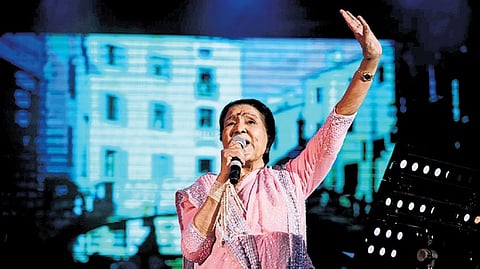

Age is just a number” is an adage Asha Bhosle believed in and lived by. Among the many facets of her long, abundant, and well-spent inning—professional as well as personal—the most distinct was the versatile voice: hearty, playful, coquettish, saucy, sensuous, spiritual, soulful and energetic by turns and the one that stayed forever youthful and timeless, just like Asha ‘Tai’ herself.
The fact that the sound of Asha remained robust was the reason why, in her over eight-decade long career in a notoriously ageist industry, she didn’t just sing for multiple films but became the voice of several generations of actresses—from Meena Kumari to Zeenat Aman to Rekha, from her contemporary Shakila in the sad version of Leke pehla pehla pyaar in CID (1956) to someone who could well be her daughter’s age, like Urmila Matondkar in Tanha tanha yahan pe jeena in Rangeela (1995).
She worked with possibly every major music director down the years: O P Nayyar, Shankar Jaikishan, Jaidev, Madan Mohan, Khayyam, the Burmans, A R Rahman and Sandeep Chowta. She sang duets with male singers across all ages, from Kishore Kumar, Mohammad Rafi, and Mahendra Kapoor to Sonu Nigam. Winner of several awards, including two National Awards, Asha received the Dadasaheb Phalke Award in 2000 and the Padma Vibhushan in 2008.
However, these markers aside, Asha became a legend of playback singing because of the extraordinary ability to imbibe the personality of the actor, get into the mood of the moment, respond to the space and setting of the sequence and catch the emotive soul of a song with the amazing texture and timbre of her voice.
She could become the innocent and impoverished street kids in Boot Polish (1954) in songs like Nanhe munne bachche teri mutthi mein kya hai, Thehar zara o janewale, Chali kaunse desh just as effortlessly as she’d be the sexy Helen in a cabaret club in Piya tu ab to aaja in Caravan (1971) or Yeh mera dil in Don (1978).
Asha’s father, Pandit Deenanath Mangeshkar, was an eminent musician himself, and so were the siblings—Lata Mangeshkar, Meena Khadikar, Usha Mangeshkar, and Hridaynath Mangeshkar. There had been tales of sibling rivalry between her and the legendary elder sister, Lata Mangeshkar, but both eventually carved enviable and influential niches for themselves and ruled the male-dominated industry with confidence and conviction.
The last of an entire generation of playback stalwarts of the Golden Era of Hindi film music, her clear vocalisation, perfect diction and right enunciation were enough for her to embrace a range of languages and dialects, both Indian and international. The range extended from classical, folk, bhajans to the Westernised cabarets and discos.
