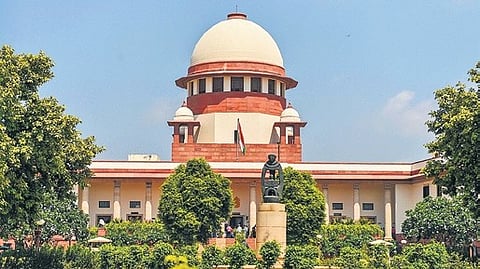

On the fifth day of hearing in the Sabarimala review pleas case, the Supreme Court’s nine-judge Constitution Bench made a significant observation, indicating that “religion” and “freedom of conscience” cannot be confined to the same scope.
The lone woman judge on the bench, Justice B.V. Nagarathna, asked senior advocate Rajeev Dhavan whether conscience is a larger concept than religion and whether it should take on the colour of religion.
Justice Ahsanuddin Amanullah, another judge on the bench, said constitutional courts have to rise above religious consciousness and look at a broader constitutional balance.
Dhavan, appearing for one of the petitioners, said that instead of deciding matters on a case-by-case basis, the court should lay down broad principles, because the law framed in the case would not remain limited to Sabarimala alone but would affect every faith, every sect and even tribal religions.
The court observed that denominational practices can be the subject of judicial scrutiny, and said judges must rise above personal religious beliefs and be guided by freedom of conscience and the broader constitutional framework while adjudicating matters of faith.
The top court was hearing a batch of review pleas related to the entry of women into the Sabarimala Temple. It is examining the scope of Articles 25 and 26, the essential religious practices doctrine and the extent of judicial review in matters of faith.
Arguments remained inconclusive on Friday and will continue on Tuesday before the same bench, led by Chief Justice Surya Kant.
During the hearing, Dhavan said Article 25(1) separately provides for freedom of conscience, meaning it is not only about the freedom to profess religion, but also the right to question the state, religion and practices in a respectful and authentic manner.
He said Article 17, which abolishes untouchability, is an independent constitutional mandate that no court or religion can set aside. However, he clarified that Justice D.Y. Chandrachud’s opinion in the original Sabarimala judgment linking the exclusion of women to Article 17 was not the majority view.
The bench also raised the question of whether a particular interpretation could create divisions in society. Dhavan responded that the responsibility to “heal” a diverse India lies largely with the court and depends on how Articles 25 and 26 are interpreted.
Dhavan also pointed to differences within the 2018 Sabarimala judgment, saying judges had differed on essential religious practices, constitutional morality and the interpretation of Article 26. According to him, a religious practice cannot be tested solely on whether removing it would change the identity of the religion.
He added that faith changes over time and social reform comes not only through law, but also through societal acceptance.
Earlier, senior advocate M R Venkatesh, appearing for Atman Trust, argued that under Article 25(2)(a), the state can regulate only the secular aspects associated with religion and cannot interfere with its core.
He said courts have taken the opposite approach by dividing religious practices into “essential” and “non-essential”, which, according to him, has constricted religious freedom and choice.
Venkatesh further argued that the practice of women voluntarily abstaining from entering temples or prayer rooms during menstruation is based on discipline and faith, not on discrimination. He said women in South India traditionally follow self-imposed restrictions during menstruation as part of religious discipline.
Apart from the Chief Justice, the bench also comprised Justices M M Sundresh, Aravind Kumar, Augustine George Masih, Prasanna B Varale, R Mahadevan and Joymalya Bagchi.
