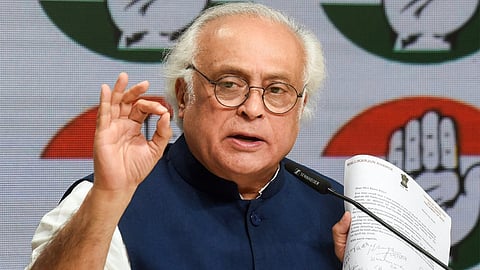

The Congress on Tuesday accused Prime Minister Narendra Modi of trying to delay the implementation of women's reservation in legislatures by tying it to delimitation, and referred to earlier letters written by Sonia Gandhi and Rahul Gandhi urging him to implement the quota immediately.
Congress general secretary in-charge communications Jairam Ramesh said Rahul Gandhi, as Congress President, had written to the Prime Minister on July 16, 2018, demanding the immediate implementation of women's reservation.
"Eight years later, the Prime Minister - keen to delay the implementation of reservations by linking it to delimitation - is still to act on this demand," Ramesh said.
He also shared Gandhi's letter to the PM from 2018, in which he had requested support to ensure the passage of the Women's Reservation Bill in the then upcoming monsoon session of Parliament.
"As you are aware, the Women's Reservation Bill, passed by the Rajya Sabha on the 9th of March, 2010, has been stalled on one pretext or the other, in the Lok Sabha, for over eight years now.
When this bill was passed in the Rajya Sabha with the support of the BJP, the then leader of the opposition, Arun Jaitley ji, called the passage of the bill 'historic and momentous'.
Since then, while the Congress party has been unwavering in its commitment to the bill, the BJP appears to have had second thoughts, even though this was one of its key promises in its 2014 manifesto," Gandhi had said.
"Mr.Prime Minister, in many of your public rallies you have spoken about your passion for empowering women and involving them more meaningfully in public life.
What better way to demonstrate your commitment to the cause of women, than by offering your unconditional support to the passage of the Women's Reservation Bill? And what better time, than the upcoming session of Parliament? Any further delay will make it impossible to implement before the next general elections," Gandhi had said.
"On the issue of empowering our women, let us stand together, rise above party politics and send India a message that we believe the time for change has come.
Women must take their rightful place in our state legislatures and in Parliament, where they are at present abysmally represented," Gandhi had said in his letter to Modi.
Ramesh also shared a 2017 letter by Sonia Gandhi, the then Congress President to the Prime Minister, urging him to get the Women's Reservation Bill passed in Lok Sabha.
"You may recall that it was, in fact, the Congress Party and its late leader Shri Rajiv Gandhi who first mooted the provision for reservation for women in panchayats and nagarpalikas in the Constitution Amendment Bills which the Opposition parties thwarted in the Rajya Sabha in 1989 but later were passed by both Houses of Parliament in 1993 becoming the 73rd and 74th Amendments," Sonia Gandhi had said.
Ramesh added, "The Congress Party’s stance has been unflinching and unchanged. It is the Modi Government that slept on this demand and has then tried to delay it by linking it to delimitation."
The Congress on Monday had said the striking down of the Modi government's delimitation push in the garb of women's quota was a defeat of "bulldozer politics" and that the Centre's agenda was not women's reservation but Prime Minister Narendra Modi's "preservation".
The opposition party had also demanded that the Centre immediately implement the women's quota on the existing Lok Sabha strength by bringing a bill in Parliament's Monsoon Session or May-end.
The Congress' assertions come days after the government's Constitution (131st Amendment) Bill to implement women's quota and increase the number of Lok Sabha seats to 816 was defeated in the Lower House on Friday.
While 298 members voted in support of the Constitution (131st Amendment) Bill, 230 MPs voted against it.
Out of the 528 members who voted, the Bill required 352 votes for a two-thirds majority.
The Bill proposed to increase the number of Lok Sabha seats to 816 from the current 543 to "operationalise" the women's reservation law before the 2029 parliamentary polls, following a delimitation exercise based on the 2011 Census.
Seats were also to be increased in assemblies of states and Union territories to accommodate a 33 per cent reservation for women.
(With inputs from PTI)
