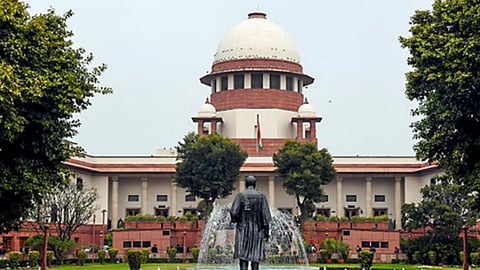

NEW DELHI: On the 10th day of hearing in the Sabarimala reference case, the Supreme Court on Wednesday questioned the petitioners how can a non-believer in north India claim the right of entry to the Sabarimala temple.
The court said that while deciding the issue on the right to enter temples, it has to examine whether a devotee or a non-devotee is claiming that right.
The observation of the nine-judge Constitution bench, headed by Chief Justice Surya Kant, came while hearing a batch of review petitions related to the discrimination against women at religious places, including Sabarimala temple in Kerala, and on the ambit of the religious freedom practised by multiple faiths.
The bench commented that women, who are true devotees of Lord Ayyappa, would not go to the Sabarimala temple till they attain the age of 50. It added that the exclusion of women between the ages of 10 and 50 years from the temple is violative of Article 25 of the Constitution.
The court also questioned a woman who visited the Sabarimala temple after the 2018 verdict which had set aside the traditional ban on women aged 10-50 years from entering the temple. Senior Advocate Indira Jaising told the bench that she was representing a woman, named Bindu, who had entered the Sabarimala temple when she was about 40 years old.
“They did a Shuddhi. She must have been about 40 years when she went. I had filed a petition in this court, and there is an order giving police protection. But she never went again. She did not have the courage to go a second time,” she added.
Jaising argued that the religious freedom guaranteed to individuals under Article 25(1) of the Constitution would prevail over the rights of religious denominations and the court cannot adopt a complete hands-off approach in religious matters, as judicial review is an inherent constitutional power.
Hearing these submissions, the bench observed that it cannot hollow out religion in the name of reform and that matters of belief and conscience cannot be subjected to judicial debate.
Justice Nagarathna had observed that Article 25(2)(b), which empowers the state to make law for social reform, is not a right in itself, and is only an enabling power. “In the name of reform, don’t hollow out the religion. Let us not open rituals and ceremonies which are there for centuries,” Justice Nagarathna said.
The hearing will continue on Thursday. Other judges in the bench included Justices Aravind Kumar, Augustine George Masih, Prasanna B Varale, Joymalya Bagchi, R Mahadevan, Ahsanuddin Amanullah and MM Sundresh.
Also in top court
SC disposes of Teesta passport plea
The SC on Wednesday disposed of activist Teesta Setalvad’s plea for release of her passport and said she may file a fresh plea as and when she fixes the itinerary to travel abroad. Setalvad had sought release of her passport deposited in a court as a bail condition in fabrication of papers to frame people in post-Godhra riot cases.
‘Ensure 22K homes for Unitech buyers’
The SC made it clear on Wednesday that its objective was to ensure that 22,000 homebuyers of the ailing Unitech Ltd got their dream homes and asked the new Centre-appointed board of the real estate group, banks and financial institutions to give suggestions for an amicable resolution of the dispute.
