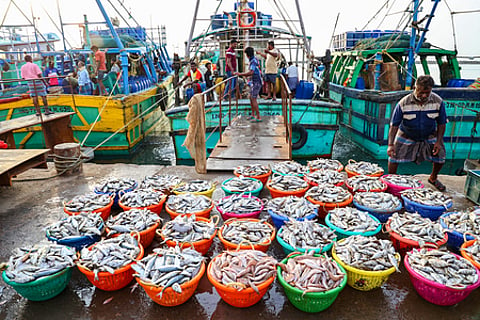

NEW DELHI: The Union Budget 2026 has drawn attention to the fisheries sector through a series of regulatory reforms, even as the financial allocation for the sector has risen only marginally, while animal husbandry and dairying have received a substantial increase in funding.
Despite the focus on fisheries in the Budget speech, the allocation for the sector has increased by just 2% compared to the previous year.
In 2024-25, the Department of Fisheries was allocated Rs 2,703.67 crore, of which only Rs 1,732.95 crore was utilised. For 2025-26, the allocation stands at Rs 2,761.80 crore.
Experts point out that while the financial outlay remains modest, the Budget introduces significant regulatory reforms in the fisheries sector that could have long-term implications.
These include amendments to customs laws aimed at boosting fisheries exports and domestic processing, as well as provisions related to the establishment of private veterinary institutes.
To promote exports and enhance the economic potential of marine resources, the government has amended the Customs Act, 1962, by introducing new provisions.
Under these changes, fish caught by Indian vessels beyond territorial waters, within the Exclusive Economic Zone or on the High Seas, will be exempt from customs duties.
Additionally, landing such fish at foreign ports will be treated as an export. The government has, however, said that safeguards will be put in place to prevent misuse during fish catch, transit and trans-shipment.
The flagship Pradhan Mantri Matsya Sampada Yojana will continue to be a key focus, with its allocation seeing a slight increase to Rs 2,500 crore compared to the previous year.
In contrast, the Department of Animal Husbandry and Dairying has received a significant boost, with its allocation rising by 27% from Rs 4,840.40 crore in 2024-25 to Rs 6,153.46 crore in 2025-26.
The livestock sector, which contributes nearly 16% to farm income, is set to see a major push through an increase of over 20,000 veterinary professionals.
This will be supported by a loan-linked capital subsidy scheme for establishing veterinary and para-veterinary colleges, veterinary hospitals, diagnostic laboratories and breeding facilities in the private sector.
The government will also facilitate collaboration between Indian and foreign institutions.
Allocations for animal husbandry and dairy development have also been strengthened, with the Livestock Health and Disease Control Programme receiving Rs 2,010 crore, up from Rs 1,980 crore in the previous year.
The Budget also places emphasis on fostering entrepreneurship in the animal husbandry sector to generate quality employment in rural and peri-urban areas.
This includes proposals to develop integrated value chains focused on livestock, dairy and poultry, and to encourage the formation of Livestock Farmer Producer Organisations.