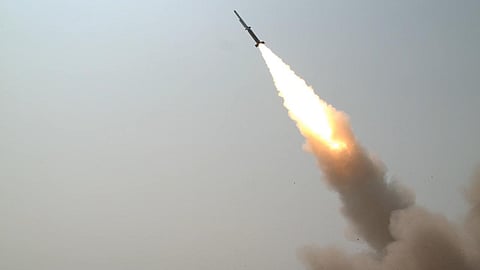

NEW DELHI: The Defence Research and Development Organisation (DRDO) on Tuesday successfully conducted a flight test of its Solid Fuel Ducted Ramjet (SFDR) technology from the Integrated Test Range (ITR) in Chandipur, Odisha, achieving a key milestone in the development of India’s next-generation long-range beyond-visual-range (BVR) air-to-air missile, Astra Mk-3 (Gandiva).
According to a statement from the defence ministry, “The successful demonstration places India into an elite league of nations possessing this technology which enables developing long-range air-to-air missiles, providing a tactical edge over adversaries."
While the ministry did not formally name the missile programme in its announcement, sources said the SFDR propulsion system is intended for the Astra Mk-3, which is expected to be a 350 km-class missile.
"All the subsystems including Nozzle-less Booster, Solid Fuel Ducted Ramjet motor and Fuel Flow Controller performed as per expectations after being initially propelled by a ground booster motor to the desired Mach Number. After initial acceleration to the required supersonic speed by a booster, the ramjet engine sustained thrust during the cruise phase of flight," said the statement. The ministry added that system performance was confirmed using telemetry, radar and electro-optical tracking instruments deployed along the Bay of Bengal coastline.
SFDR propulsion represents a significant technological leap over conventional solid rocket motors used in most existing air-to-air missiles, including Astra Mk-1 and the under-development Astra Mk-2. While the Mk-2 is expected to push ranges beyond 200 km using an improved rocket motor, SFDR-powered missiles are designed to go much farther by sustaining thrust throughout flight rather than burning out shortly after launch.
Unlike conventional rockets, a ducted ramjet ingests atmospheric oxygen and allows controlled combustion of solid fuel across different flight phases. This results in higher sustained speeds, superior energy retention in the terminal phase and a much larger no-escape zone against fast, manoeuvring targets, especially critical in contested airspace.
Globally, ramjet-powered air-to-air missiles remain rare due to the complexity of propulsion control at supersonic speeds. MBDA’s Meteor, which is in service with India, uses a solid-fuel ramjet with variable thrust control and is widely regarded as the benchmark in long-range BVR combat.