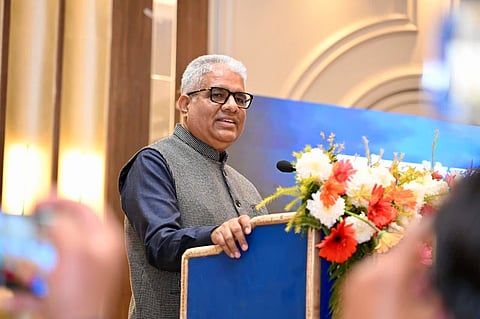

NEW DELHI: Union Environment Minister Bhupender Yadav on Saturday called for the review of all policy decisions made during the 28 meetings of the National Tiger Conservation Authority (NTCA) over the past five decades.
The minister was addressing the inaugural session of the 'Conference of Chief Wildlife Wardens of Tiger Range States and Field Directors of Tiger Reserves' in Rajasthan.
Yadav explained that this review would help identify outdated decisions, those that could not be implemented, and those that have been successfully executed.
Such analysis will allow tiger conservation policy to adapt to current challenges and ensure effective implementation of conservation measures on the ground.
The Minister called for the formation of four working groups, each focused on a different tiger zone: North, South, East, and West. These groups will analyse past policy decisions related to tiger conservation over the last 50 years.
They are tasked with preparing reports that assess the relevance of these policies and recommend the removal of outdated practices. Besides, they will examine region-specific challenges, trends in tiger populations, their prey bases, the factors contributing to population changes, the needs of frontline staff, and gaps in the implementation of centrally sponsored schemes. The four working groups are expected to submit their reports before the 29th NTCA meeting.
Furthermore, the Minister urged participants to discuss ways to enhance coordination between the NTCA and key institutions such as the Wildlife Institute of India, Botanical Survey of India, Zoological Survey of India, and the Indian Council for Forestry Research and Education.
The goal is to incorporate research inputs from these organisations to achieve practical benefits in tiger conservation.
Yadav also emphasised the need for a standardised framework for rescue, rehabilitation and transit treatment centres around tiger reserves. “As tigers and other wildlife move beyond core areas and encounter injuries or conflict-related cases, timely and professional intervention is essential,” he said.
The two-day conference in Alwar will also address conservation priorities, implementation challenges, and emerging needs in an integrated manner.
Discussions will focus on important national issues, including the review of the All India Tiger Estimation 2026, protection and patrolling mechanisms, active management of tiger populations, infrastructure for rescue and rehabilitation, management of human-wildlife interactions, utilization of funds under Project Tiger, and strengthening Tiger Conservation Foundations.
Pending issues, such as tiger mortality cases, will also be reviewed to better align financial, administrative, and technical processes with field requirements.
