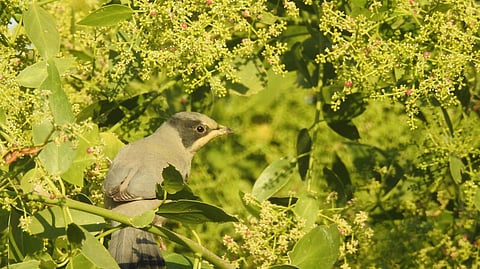

AHMEDABAD: The rare Grey Hypocolius has put Gujarat’s Chhari-Dhandh wetland in Kachchh on the global birdwatching map, drawing international birdwatchers to the newly declared Ramsar site and highlighting the state government’s sustained focus on conserving natural heritage.
A pale-grey bird from the deserts of West Asia has quietly put Gujarat’s Kachchh on the global birdwatching map, as the rare Grey Hypocolius transforms the Chhari-Dhandh Conservation Reserve into a magnet for foreign tourists, ornithologists and wildlife photographers alike. Recently recognised as a Ramsar wetland, Chhari-Dhandh is witnessing a steady rise in international footfall, driven largely by sightings of this elusive migratory species.
With over 283 bird species recorded in and around the wetland, Chhari-Dhandh was always rich in avian diversity, but experts say the presence of a few rare migrants has pushed it into the global spotlight. At the top of that list is the Grey Hypocolius (Hypocolius ampelinus), locally called Maskati Latoro, a slender passerine that breeds across Iraq, Iran, Afghanistan and Pakistan before wintering in the arid scrublands of Kachchh.
“This is the most reliable site in India to observe the Grey Hypocolius,” wildlife photographers from Kachchh say, adding that “for global birders, Chhari-Dhandh is now a must-visit destination.” They note that the Ramsar tag has further amplified international interest, placing the wetland firmly on the world’s conservation and ecotourism radar.
Birdwatchers tracking the species say the Grey Hypocolius arrives in the Fulay scrub forest between October and November and remains until March or April, moving in small flocks through arid scrub, desert edges and nearby farmlands. Feeding largely on ripe berries of Salvadora persica, locally known as Piloodi or Khari Jar, along with flower petals and berries of Tankara, the bird is often detected by its distinctive squeaky wails and whistles before it is seen.
Historical records underline Kachchh’s long but patchy association with the species. Two Grey Hypocolius specimens were collected from the Great Rann of Kachchh in March 1960 at Kuar Bet, after which sightings disappeared for decades. The bird was rediscovered in January 1990, when noted ornithologist S. N. Varu spotted a female at Fulay village in the Banni grasslands, marking a turning point in its documentation in India.
Beyond the Hypocolius, Chhari-Dhandh continues to draw attention for hosting the White-naped Tit (Machlolophus nuchalis), an endemic Indian species that further adds to the site’s ornithological importance. The wetland was declared Gujarat’s first Conservation Reserve in 2008 under the Wildlife (Protection) Act, 1972.
Officials say focused efforts to protect wetlands and fragile ecosystems have strengthened biodiversity safeguards across the state. The results are increasingly visible at Chhari-Dhandh, where 11 globally threatened and nine Near Threatened bird species have now been recorded, reinforcing its high conservation value.
As migratory birds continue to return each winter, Chhari-Dhandh stands as both a sanctuary for rare species like the Grey Hypocolius and a living showcase of Gujarat’s growing reputation as a global destination for nature and conservation tourism.