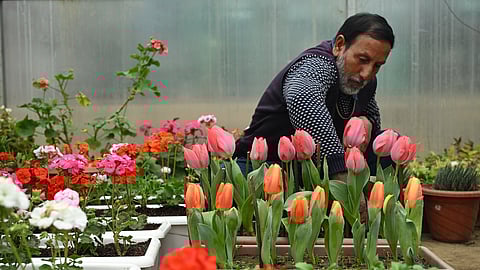

SRINAGAR: Months ahead of the usual spring bloom in Srinagar’s famed Tulip Garden, scientists at Sher-i-Kashmir University of Agricultural Sciences and Technology (SKUAST) have achieved a breakthrough by successfully inducing tulip flowering in winter, with blooms appearing in December for the first time at the research garden of the University. The scientists used advanced bulb programming and forcing technique to achieve the result.
The winter bloom was achieved at the research garden of SKUAST at Shalimar in Srinagar in late December and early January under carefully controlled conditions.
It marks a significant milestone for floriculture research in the Valley.
Imtiyaz Nazki, Professor and Head of Floriculture Department at SKUAST, Srinagar told TNIE that breakthrough was the result of introducing bulb programming and forcing techniques for the first time in Kashmir.
“There is a scientific process called bulb programming which ensures that bulbs grow out of season,” he said. “We introduced this technique in the Valley as an initial experiment, and it proved successful. We had timed the flowering for Christmas and New Year, and we were successful.”
Of the 5,000 tulip bulbs of five different varieties planted in the research garden, around 70 percent successfully bloomed.
Nazki said the results exceeded expectations.
“We were not expecting such encouraging results in the first year itself,” he said. “Some bulbs did experience flower abortion. These are early days, but we have made a strong beginning,” he said.
The bulbs used in the experiment were fourth- and fifth-generation bulbs originally sourced from Holland and subsequently grown in Kashmir.
According to Nazki, the objective was to assess whether locally grown bulbs could be programmed for off-season flowering.
“For this process, specialised infrastructure is required,” he noted. “Temperature-controlled environment is essential, including special cold storage facilities and bulb programming chambers. The bulbs are kept in the programming chambers for 12 to 18 weeks, and sometimes up to 20 weeks, during which they are exposed to a series of carefully regulated temperatures.”
The programming chambers simulate the natural conditions that bulbs need, he said.
Once the programming phase ends, the bulbs are transferred to a greenhouse or controlled chamber where temperatures of 18 to 20 degrees celsius are maintained. Under these conditions, the bulbs bloom within approximately 20 days.
According to Nazki, since the tulip bloomed around Christmas and New Year, the programming for the bulbs had begun about 16 weeks earlier.
The successful winter tulip bloom opens new commercial possibilities for Kashmir’s floriculture sector.
Tulips, traditionally associated with spring, can now potentially be cultivated for high-demand occasions such as Christmas, New Year and other winter events, when demand for flowers increases manifold and commands premium prices.
While bulb programming and forcing are routine practices in Holland due to advanced technology and infrastructure, the technique has been introduced in Kashmir for the first time.
“Holland does this at a bulk commercial level,” Nazki said. “For Kashmir, it will be a gradual process. But this experiment shows that the potential exists to scale up and target different occasions and markets in the future.”