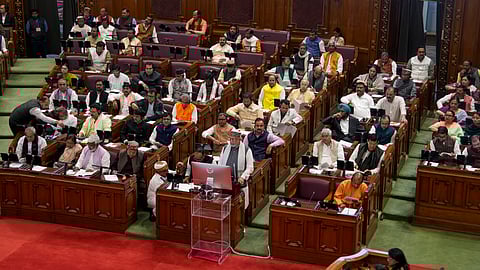

LUCKNOW: The Uttar Pradesh government on Wednesday presented its biggest-ever Budget of over Rs 9.12 lakh crore for 2026–27, the last before next year’s Assembly elections, with a special focus on girls’ welfare, healthcare infrastructure and employment.
The Budget 2026–27, presented by Finance Minister Suresh Khanna in the state Assembly, is 12.9 per cent higher than the previous year’s outlay of Rs 8.08 lakh crore.
Presenting the budget, Khanna announced a Rs 43,000 crore package for new schemes. He also announced the establishment of 16 new medical colleges and three universities, and said financial assistance for daughters’ marriages would be increased from Rs 50,000 to Rs 1 lakh.
Chief Minister Yogi Adityanath described the budget as one focused on “safe women, empowered youth, prosperous farmers and work for every hand”. He said Uttar Pradesh was becoming technologically advanced and prosperous, adding that the 2026–27 budget had taken every section of society into account.
The budget provides Rs 100 crore for the development of Ayodhya. In addition, Rs 800 crore has been earmarked for the development authorities of Meerut, Mathura-Vrindavan and Kanpur.
An allocation of Rs 2,374 crore has been made for providing free tablets and smartphones to students.
The budget mentions the proposed establishment of an Artificial Intelligence Mission, with a provision of Rs 225 crore. The government has promised to provide employment to 10 lakh youth and allocated Rs 400 crore for distributing scooties to girl students.
“With MSMEs and skill development, Uttar Pradesh is set to grow as an employment generator. We are moving forward on the principle of public trust,” Yogi said while addressing the media after the budget presentation in the Assembly.
The Chief Minister said that over the past nine years, the government had successfully changed public perception. “In these nine years, the state budget has more than tripled,” he said.
He added that with Rs 43,565 crore proposed for new schemes, over Rs 2 lakh crore was being spent on new construction to boost employment and growth.
“This is our government’s 10th budget. It is the first time any chief minister has had the opportunity to present a budget ten times. In these nine years, not a single additional tax has been imposed,” Yogi said.
The Chief Minister said complaints of tax evasion in Uttar Pradesh had been addressed. “We have succeeded in taking the state from a ‘sick’ state to being presented before the nation as a ‘revenue-surplus’ state,” he said.
Key allocations include Rs 34,468 crore for roads and bridges, Rs 100 crore for working women hostels, Rs 315 crore for a cancer institute in the state capital Lucknow, and Rs 3,822 crore for MSMEs.
Presenting the budget, Finance Minister Khanna said capital expenditure had been pegged at 19.5 per cent of the total outlay. Sector-wise allocations include 12.4 per cent for education, 6 per cent for health, and 9 per cent for agriculture and allied activities.
The state’s Gross State Domestic Product (GSDP) is estimated at Rs 30.26 lakh crore, reflecting a growth rate of 13.4 per cent. Per capita income is projected to rise to Rs 1.2 lakh in 2026–27. Khanna also said the unemployment rate has declined to 2.24 per cent.
Khanna said the budget adheres to the 3 per cent fiscal deficit limit in line with the recommendations of the 16th Finance Commission, applicable till 2030–31.
The state’s debt-to-GSDP ratio, which stood at 29.3 per cent in 2016–17 and rose to 33.4 per cent during the pandemic, has been brought down to below 27 per cent in 2024–25. It is targeted to decline further to 23.1 per cent in 2026–27, with a medium-term goal of reducing it to below 20 per cent, the minister said in his budget speech.