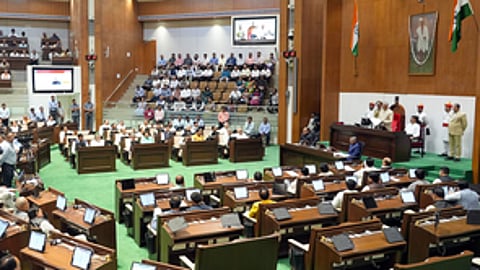

AHMEDABAD: BJP’s Purnesh Modi and Congress’s Shailesh Parmar are contesting for the Deputy Speaker post in the Gujarat Assembly following the resignation of Shahera MLA Jethabhai Bharwad.
In a pivotal election on February 16, numbers favour the BJP, but the Opposition is to play the constitutional convention card.
The sudden vacancy of the Deputy Speaker post has instantly set off intense party-level brainstorming, which, in turn, fast-tracked the search for a suitable candidate, keeping the upcoming assembly session firm on focus.
With the nomination deadline closing on February 13 afternoon, the contest lines were decisively drawn between Purnesh Modi and Shailesh Parmar. The swift filing of nominations converted what could have been a routine procedural election into a politically charged direct face-off.
The election for the Deputy Speaker post is now poised to become a symbolic yet sharp political contest inside the House, where the BJP’s numerical dominance stands tall, but Congress’s entry signals a deliberate attempt to assert Opposition presence within the constitutional framework.
The strategic consultations within both camps ultimately culminated in the last-minute but decisive nomination battle.
Purnesh Modi is a leader known for his long administrative innings and deep organisational roots. Due to the background, his prospective role in steering the Assembly proceedings and assisting the Speaker is seen as crucial if he secures the post.
On the other side, Congress MLA Shailesh Parmar has entered the fray with a clear political argument rooted in parliamentary convention, asserting that the Opposition should receive representation in such constitutional posts to maintain democratic balance inside the legislature.
The ruling party enjoys an overwhelming numerical edge in the 182-member House, yet Congress’s move to field a candidate is widely interpreted as a calibrated political signal aimed at reinforcing the principle of Opposition space rather than merely chasing electoral arithmetic.
Under Assembly rules, the Deputy Speaker assists the Speaker in managing the House and presides over proceedings in the Speaker’s absence. Due to the pivotal role in maintaining legislative order and continuity, the post carries considerable constitutional weight despite being often overshadowed by numbers.
The arithmetic, however, remains decisive: out of 182 seats in the 15th Gujarat Legislative Assembly, BJP holds 162 seats, Congress 12 seats, Aam Aadmi Party 4 seats, Samajwadi Party 1 seat and Independents 3 seats.
The overwhelming majority clearly tilts the electoral balance in favour of the ruling party even before the voting begins.
State spokesperson and minister Jitu Vaghani underscored the BJP’s position, stating, “Purnesh Modi, who has worked with commendable performance and vision, has filled the form following the instructions of the MLAs, Chief Minister and Deputy Chief Minister. He has always worked according to the system by keeping everyone together.”
He further added, “We do not want to create a political controversy, but it is not right for the constitutional system for Congress to use words incorrectly, as Congress was voted by the people in such a way that the Opposition does not get a post.”
Countering this, Congress’s Danilimda MLA Shailesh Parmar invoked constitutional convention and said, “According to the country's Constitution, it has been a tradition to provide the post of Speaker to the ruling party and the post of Deputy Speaker to the Opposition. It should be followed in Gujarat too. I have been an MLA for five terms and have also received the Best MLA award in 2017, yet the Opposition does not get proper representation.”
Thus, while the ruling BJP rides on a comfortable majority perk, Congress’s candidature transforms the election into a symbolic ideological contest: convention versus numbers.