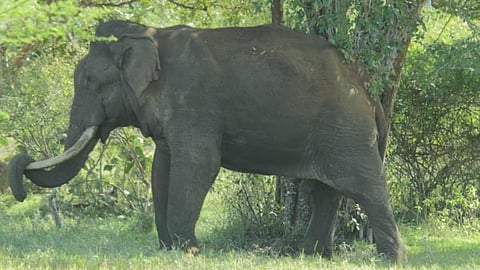

LUCKNOW: Panic gripped the villages along the Indo-Nepal border in Bahriach district, with two deaths happening in a span of the last 24 hours by a herd of elephants, in Katarniyaghat Wildlife Division.
On Saturday, a woman, 47, was attacked and trampled to death by an elephant belonging to the herd while she was travelling with her two sons on a motorbike in the Nashangarh range. Both of her sons are grievously injured.
On Sunday, around 30 tuskers allegedly attacked a priest, in his 80s, in Katiyara forest outpost of the same range.
The priest identified Suresh Das was rushed to a nearby hospital where the doctors declared him dead upon arrival.
As per the local sources, the masquerading herd surrounded the forest outpost, forcing forest personnel positioned there to flee.
They could return only after the elephants retreated and additional staff reached the spot on receiving information about the incident. “Staff at the outpost had a narrow escape last evening,” said Divisional Forest Officer (DFO) Apoorva Dixit.
“The body of the priest has been sent for post-mortem, and its report is awaited.” Das, a resident of Bardia village near the forested stretch, had been looking after a temple in Katiyara beat near the outpost.
As per the local sources, in the core zone of Katarniyaghat wildlife sanctuary, Katiyara beat forest is situated near the Kothiya ghat along the Indo-Nepal border.
The temple is situated at 200 metres from the Katiyara forest outpost.
The victim priest used to live in a hut near the temple and perform puja, besides ensuring the upkeep of the temple. The hut of priest Suresh Das was attacked by the herd of elephants at around 9 pm.
The herd of about 30 pachyderms trampled the hut and the priest.
The sources added that, hearing the screams and the rumbles of elephants who had just decimated the entire area, the forest personnel positioned at the outpost tried to save the priest, but they had to flee to save their life from the charging tuskers.
Meanwhile, Katarniyaghat range forest area officer Ashish Gaur confirmed the incident, saying that a rescue team was immediately sent to the affected area after getting the information of the presence of the herd but it was challenging to reach the spot amid the heightened activity of a herd in the area.
The forest department is also awaiting the autopsy report of Munni Devi, who lost her life on Saturday.
In a video doing the rounds locally, her son Karan is purportedly heard saying they went to Bahraich from their home in neighbouring Lakhimpur Kheri to consult a doctor and buy medicines.
They were returning on a motorcycle when they were attacked by elephants, he claimed. Over the past few months, multiple cases of elephant attacks have been reported, with the animals damaging homes, attacking residents and destroying standing crops in several villages.
As per the forest department sources, the herd, involved in the recent attacks, might have crossed over from Nepal’s Shuklaphanta National Park which lies close to the international border, in search of food and water.
The department is keeping a close watch on the herd’s movements and mapping its routes.
Teams on the ground are trying to avert further human-elephant encounters by warning villagers in advance and discouraging movement near forested stretches, particularly after sundown.
The forest department keeps on rolling out the safety advisories for residents living inside forest fringes and adjoining areas.
Authorities issue appeals to people to be alert while moving in areas close to the border.
Teams have been going from village to village to inform locals about the movement of the herd and caution them against venturing into vulnerable zones.
In an effort to drive the elephants away, forest workers are lighting heaps of hay laced with chilli powder, sounding hooters and bursting firecrackers to generate loud noise.
