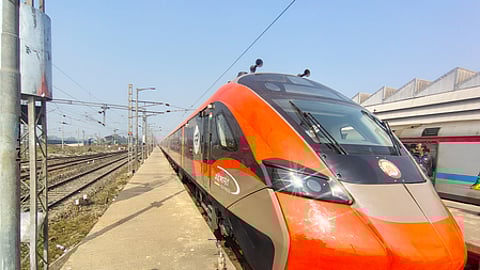

CHANDIGARH: Union Minister of State for Railways Ravneet Singh alias Bittu said that a Vande Bharat sleeper train will be launched next winter between Delhi and Amritsar.
The train will travel via Chandigarh, Ludhiana and Jalandhar.
Ravneet said that land has been identified at Ladhowal near Ludhiana for a loco-shed, mandatory at terminal points.
Works on Railway Over Bridges (ROB), Railway Under Bridges (RUB), and Low Height Subways (LHS) are currently underway at 166 locations across the State, with a total investment of Rs 1,480.09 crore.
He underscored that there is no shortage of funds for railway infrastructure development in Punjab and reiterated the government’s strong commitment to modernising and expanding the rail network in the State.
He further highlighted that the annual railway budget allocation for Punjab today is nearly 25 times higher than during the 2009–2014 period, amounting to Rs 5,673 crore.
Currently, infrastructure projects worth Rs 26,382 crore are in progress across Punjab, encompassing new track construction, station redevelopment, safety enhancement measures, and other capacity augmentation initiatives.
Additionally, 30 railway stations in the State are being comprehensively redeveloped under the Amrit Bharat Station Scheme, with a total investment of Rs 1,311 crore, aimed at providing modern passenger amenities and improved facilities.
Singh said that the construction of the 3rd and 4th railway lines between Delhi and Ambala has been approved.
This significant project forms part of the broader initiative to quadruple the highly utilised Delhi–Jammu corridor, a crucial arterial route linking the National Capital Region with northern states.
The Delhi–Ambala section is among the busiest rail corridors in the country, handling substantial passenger and freight traffic.
The addition of the third and fourth lines will greatly enhance line capacity, improve operational efficiency, and reduce congestion.
Covering a route length of 194 kilometres and estimated at a cost of Rs 5,983 crore, the project is scheduled for completion within four years.
It will pass through the districts of Sonipat, Panipat, Karnal, Kurukshetra, and Ambala in Haryana, as well as Central, North West, and North Delhi.
The enhanced capacity will allow for the introduction of additional passenger and freight trains, improving punctuality and service reliability.
The corridor connects key economic nodes, including thermal power plants at Ropar, Panipat, and Rajpura, in addition to agriculture warehouses and industrial hubs.
By facilitating smoother freight movement, the project will also strengthen supply chains and contribute to economic growth.
The upgraded corridor will also improve connectivity to major pilgrimage and tourist destinations such as Shri Mata Vaishno Devi Katra, Srinagar, Jammu, and Shimla, thereby boosting tourism and regional development.
In addition, the project is expected to facilitate approximately 24.6 million tonnes of additional freight traffic annually, easing pressure on existing infrastructure.
It will generate significant environmental benefits, including estimated annual CO₂ savings of 43 crore kilograms—equivalent to planting around 1.7 crore trees.
Logistics cost savings of approximately Rs 952 crore per year are projected, enhancing overall economic competitiveness.
During the construction phase, the project is expected to generate employment amounting to 132 lakh days.
The construction of the four-lane Railway Over Bridge (ROB) at Level Crossing No. 164AB in Doraha will emerge as a landmark infrastructure project, significantly strengthening connectivity between the Malwa region, the capital of Punjab, and adjoining districts, said Singh.
He stated that the project, estimated to cost Rs 70.55 crore, will be completed within the next year.
He emphasised that the work will now proceed on a war footing and the bridge will be opened to the public at the earliest, bringing long-overdue relief to commuters who have faced inconvenience at the level crossing for nearly 12 years.