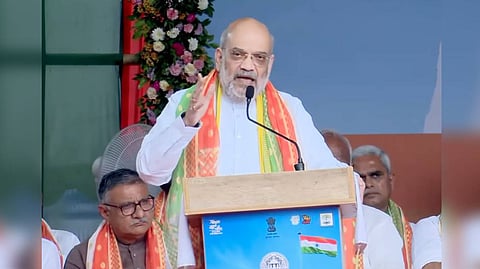

NEW DELHI: Union Home Minister Amit Shah will embark on a three-day visit to Bihar beginning February 25, during which he is scheduled to hold extensive deliberations with local authorities and security agencies, including the Sashastra Seema Bal (SSB) with regard to concerns related to alleged demographic changes, infiltration, and unauthorised religious constructions in sensitive border districts, sources said.
A key highlight of the tour will be high-level review meetings in Bihar’s Seemanchal region, which are described by the sources as the first initiative of its kind at this scale.
The Home Minister is set to chair a comprehensive session involving District Magistrates (DMs) and Superintendents of Police (SPs) from seven districts, including Kishanganj, Araria, Purnia, Katihar, Madhepura, Saharsa, and Supaul, the sources said, adding that these districts lie along or in close proximity to the India-Nepal and India-Bangladesh borders and have historically been regarded as sensitive due to cross-border movement and internal security considerations.
During the three-day engagements, Shah is expected to give focused attention to issues of demographic shifts, instances of illegal infiltration and the status of religious structures allegedly constructed without required approvals from the authorities, they said.
The sources indicated that detailed presentations will be made by district administrations and police officials, incorporating intelligence assessments and ground-level reports. The deliberations aim to assess the prevailing situation comprehensively and identify vulnerabilities that may require corrective measures, the sources said.
The Home Minister is likely to stress the need for close coordination between civil administration and law enforcement agencies to effectively address security concerns. “Clear directives are expected on improving synergy between district authorities and policing units, particularly to tackle infiltration and unauthorised constructions,” a source said.
He suggested that Shah’s direct engagement at the district level signals a more granular review of developments in the region, marking the first time he will chair such meetings focused specifically on demographic and infiltration-related issues at this administrative tier.
The move is being viewed as an indication of the Centre’s heightened focus on Seemanchal, a region that has figured prominently in political and security discourse in recent years. Its geographical proximity to international borders, combined with a complex socio-economic landscape, has also made it an area of sustained strategic interest for both state and central authorities.
Beyond the Seemanchal-specific review, Shah will also preside over broader meetings concerning Bihar’s overall internal security architecture. These discussions are expected to encompass border management practices, intelligence-sharing mechanisms, policing strategies and preparedness against organised crime and extremist elements.
Senior officials from the Union Ministry of Home Affairs will accompany the Home Minister, including Union Home Secretary Govind Mohan and Intelligence Bureau Director Tapan Deka. Their participation is expected to ensure that intelligence-based assessments and field inputs inform the review process and any subsequent policy decisions.
In addition, Shah is scheduled to hold a dedicated meeting with the SSB, the central armed police force tasked with guarding the India-Nepal border. Deliberations are anticipated to focus on strengthening border surveillance, enhancing intelligence-sharing frameworks, and curbing illegal cross-border activities. Given Bihar’s long and porous boundary with Nepal, reinforcing coordination between state police forces and central agencies remains a priority for the government.
The sources suggested that the outcomes of these meetings could lead to tighter monitoring systems, improved inter-agency collaboration, and targeted administrative interventions in districts identified as particularly sensitive.