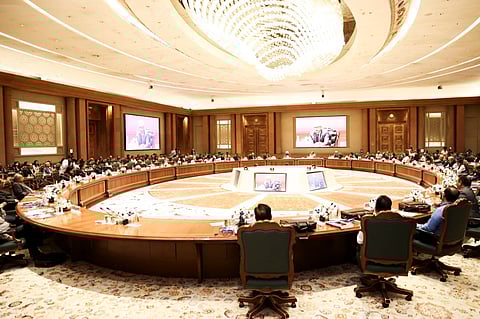

NEW DELHI: The Election Commission of India (ECI) on Tuesday convened a day-long National Round Table Conference with State Election Commissioners here, marking the first such engagement in 27 years.
The conference concluded with the unanimous adoption of the National Declaration 2026, underscoring a shared commitment to strengthening India’s democratic framework through cleaner electoral rolls and closer institutional cooperation.
Addressing the gathering, Chief Election Commissioner Gyanesh Kumar stressed that the purity of electoral rolls remains the bedrock of a healthy democracy. He said that in the national and constitutional interest, the ECI and State Election Commissions (SECs) must work in synergy, keeping the elector at the centre of all processes.
“Preparation of pure electoral rolls is the foundation of democracy and transparent and efficient conduct of elections further strengthens democratic values,” the CEC noted.
The declaration adopted at the conference called for evolving mutually acceptable mechanisms and legally viable frameworks to enhance cooperation between the ECI and SECs across the country.
It proposed collaboration in key areas, including the sharing of ECINET, Electronic Voting Machines (EVMs), electoral rolls and training infrastructure at the India International Institute of Democracy and Election Management (IIIDEM). ECINET is a digital platform to simplify election related services.
Participants also discussed aligning laws governing panchayat and municipal elections with those applicable to Parliament and State Legislatures to ensure greater coherence in electoral governance.
During the conference, detailed presentations were made on EVMs and ECINET, alongside discussions on best practices related to electoral roll revision and election management. The ECI urged SECs to actively participate in its international engagements and proposed that the National Round Table Conference be institutionalised as an annual event, preferably alongside global conferences chaired by the Commission.
The poll body said that suggestions received from SECs during the conference would be examined by a joint team of legal and technical officers led by concerned Deputy Election Commissioners. A state- and Union Territory-wise roadmap will be submitted to the ECI within three months to facilitate informed decision-making in the national interest.
State poll panels take ECI's electoral rolls, used for assembly polls, and employ them as per their requirements for holding local body polls.
The shelf life of an EVM is 15 years, and machines at the end of their life cycle are usually given to state poll panels for holding local elections.
The ECI at present uses 'M3' or Mark III type of EVMs to hold Lok Sabha and assembly polls. The ECI does not charge states for using their EVMs. Once an EVM leaves the ECI's custody, it is no longer called ECI-EVM. Machines that complete their life cycle are destroyed under security.
The Union law ministry is provided funds in the Union budget to help ECI buy required EVMs from Electronics Corporation of India Ltd (ECIL) and Bharat Electronics Ltd (BEL) -- the two PSUs that manufacture the voting machines.
The ECI will also offer to help state ECs develop technology platforms similar to ECINET, as well as training support for their officials in election management.
Earlier in the day, Kumar highlighted the ongoing Special Intensive Revision (SIR) exercise aimed at including all eligible electors while removing ineligible names from the rolls. He said the exercise is currently underway in 12 states, with 11 having already published their updated electoral rolls.
(With inputs from PTI)
