
DEHRADUN: Rashtriya Swayamsevak Sangh (RSS) chief Mohan Bhagwat has termed the Agniveer scheme, a key component of the government's national security strategy, an "experiment" that needs to be evaluated and refined based on experience.
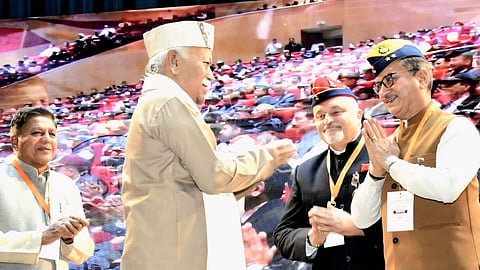
Addressing a gathering of former military officers at the Himalayan Cultural Center during the final leg of his three-day Uttarakhand visit, Bhagwat emphasized that national security is intrinsically linked to the strength of society.
Commenting on the Agnipath initiative, which has seen polarized political and social debate, the RSS chief noted that any major strategic shift requires a feedback loop.
"The Agnipath scheme should be viewed as an experiment. Based on the experience gained and the feedback received, there should be a focus on necessary improvements and modifications," Bhagwat stated.
He further underscored that excellent leadership and military readiness are non-negotiable for a sovereign nation, but added that a "disciplined and character-driven leadership" is what ultimately sustains the state.
Responding to queries regarding the evolving geopolitical situations in Nepal, Bangladesh, and Kashmir, Bhagwat took a firm historical and cultural stance. He remarked that these regions have historically been part of a unified cultural landscape. Reaffirming Kashmir as an "integral and inseparable" part of India, he called for a "stringent policy" against anti-India agendas and insurgent narratives.
The RSS chief touched upon sensitive socio-political issues, including the Uniform Civil Code (UCC) and the necessity of social inclusion. "The Hindu society is inherently liberal and inclusive. Public spaces—be it temples, water sources, or crematoriums—must be equally accessible to everyone without exception," he said, invoking the spirit of 'Vasudhaiva Kutumbakam.'
On the UCC, Bhagwat described it as a vital tool for national integration. Regarding reservation policies, he advocated for "social consensus and patience," emphasizing that the goal is social equity.
Addressing the issue of population dynamics, the Sarsanghchalak expressed concern over what he termed "demographic imbalance."
He identified three primary drivers that require a comprehensive national policy: illegal infiltration, religious conversions, and disparities in birth rates.
Turning his attention to the local context of Uttarakhand, Bhagwat highlighted the "ghost village" phenomenon caused by mass migration from the Garhwal hills. He urged the government and civil society to prioritize education, healthcare, and local entrepreneurship to ensure that the youth find sustainable livelihoods within their home state.