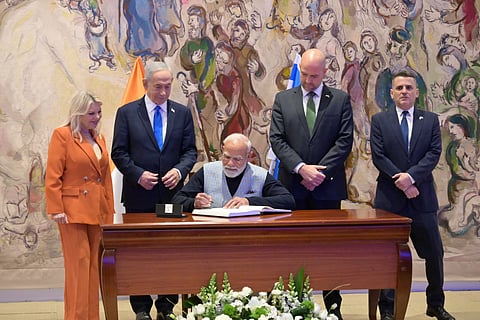

In the first ever address by an Indian Prime Minister to the Israeli Parliament, Knesset, Narendra Modi on Wednesday stressed that India firmly stands with Israel in the fight against terrorism.
Framing India-Israel ties through the lens of shared security challenges and historical bonds, Modi recalled that more than 4,000 Indian soldiers laid down their lives in the region during World War I. He said the relationship was rooted in “blood and sacrifice,” not merely diplomacy.
In a direct reference to the October 7 Hamas assault and the 2008 Mumbai attacks, Modi drew parallels between the two nations’ experiences. "I also carry with me the deepest condolences of the people of India for every life lost and for every family whose world was shattered in the barbaric terrorist attack by Hamas on October 7," he said.
“We feel your pain. We share your grief. India stands with Israel firmly, with full conviction, in this moment and beyond,” he said. “No cause can justify the murder of civilians. Nothing can justify terrorism,” Modi asserted, underlining India’s “consistent and uncompromising policy of zero tolerance for terrorism, with no double standards.”
He warned that terrorism seeks “to destabilise societies, block development and erode trust,” adding that “countering terrorism requires sustained and coordinated global action, because terror anywhere threatens peace everywhere.”
Even as he struck a hard line on terror, Modi balanced his remarks with a call for diplomacy. “The road to peace is not always easy, but India joins you and the world for dialogue, peace and stability in this region,” he said, expressing support for efforts that could lead to a durable peace, including in Gaza.
PM Modi also noted that he was born on September 17, 1950, the same day India formally recognised Israel.
"It is a privilege and honour for me to stand before this distinguished house. I do so as the Prime Minister of India and also as a representative of one ancient civilisation addressing another," he said.
"Nine years ago, I had the good fortune to be the first PM of India to visit Israel, and I'm very happy to be here again, returning to a land to which I always felt drawn. After all, I was born on the same day that India formally recognised Israel, September 17, 1950," he added.

Israeli Prime Minister Benjamin Netanyahu hailed the visit as historic, calling the partnership “an enormous multiplier of our individual powers.” Terming Modi as “a great friend to Israel, a great champion of the Israeli-Indian alliance, and a great leader on the world stage,” Netanyahu said the deep personal rapport between the two leaders reflected the strength of bilateral ties.
Hailing deep trade and cooperation between Israel and India, Netanyahu described Modi as 'more than a friend, a brother'. He spoke about the common interests that both countries share and thanked Modi for standing by Israel during the October 7 attacks in Israel.
“You stood next to Israel, you stood by Israel, you stood for Israel, you stood for the truth. Thank you, my friend," said Netanyahu.
Elevated to a strategic partnership in 2017, India–Israel relations have expanded significantly in defence, technology, cybersecurity and innovation. Modi’s visit -- his second as Prime Minister -- comes amid heightened regional tensions, reinforcing converging geopolitical interests and deepening security cooperation between the two countries.
The Knesset on Wednesday conferred the “Speaker of the Knesset Medal” its highest honour -- on PM Modi, recognising what Israeli leaders described as his personal contribution to strengthening strategic ties between India and Israel. In his remarks, Modi also outlined plans to broaden the economic pillar of the partnership, including negotiations toward an “ambitious” Free Trade Agreement (FTA). “We are committed to expanding trade, strengthening investment flows, and promoting joint infrastructure development,” he said.
Referring to the Bilateral Investment Treaty signed last year, Modi said it would “provide confidence and predictability to our businesses.” He noted that India has concluded several major trade agreements in recent years, citing deals with the European Union and the United Kingdom to Israel’s west, and the United Arab Emirates and Oman to its east.
This is Modi’s second visit to Israel in nine years. During his landmark 2017 trip, bilateral ties were elevated to a strategic partnership, setting the stage for deepening cooperation across sectors.
In his pre-departure statement, Modi said India and Israel share a partnership that has witnessed “remarkable growth and dynamism” in recent years. He expressed confidence that the visit would consolidate enduring bonds, set new goals for the strategic partnership and advance a shared vision for a “resilient, innovative and prosperous future”.
The Prime Minister said he looks forward to discussions with Netanyahu to expand cooperation in science and technology, innovation, agriculture, water management, defence and security, trade and investment, and people-to-people ties. The two leaders are also expected to exchange views on key regional and global developments.
During the visit, Modi is scheduled to meet Israeli President Isaac Herzog and will address the Israeli Parliament, the Knesset, becoming the first Indian Prime Minister to do so. He will also hold a brief meeting with Netanyahu ahead of the address, followed by wide-ranging talks on Thursday.
The visit assumes added significance amid ongoing tensions in the Middle East, including strained ties between the United States and Iran.
In recent years, India-Israel cooperation has expanded in defence, cybersecurity, scientific research and innovation. Defence has emerged as a key pillar, with Israel supplying a range of military platforms and weapon systems to India. During the visit of India’s defence secretary to Israel in November last year, an important agreement on defence cooperation was signed.
As India pursues development of an indigenous air defence shield dubbed “Sudarshan Chakra”, New Delhi is also exploring the possibility of incorporating certain elements from Israel’s Iron Dome all-weather air defence system capable of intercepting missiles and artillery shells.
Trade and investment ties are also progressing steadily. During Commerce Minister Piyush Goyal’s visit to Israel in November, the terms of reference for launching negotiations on a Free Trade Agreement were signed. In September, the two sides inked a Bilateral Investment Agreement to further expand economic cooperation.
People-to-people ties remain a vital component of the relationship, with an over 41,000-strong Indian diaspora in Israel contributing significantly to bilateral goodwill and engagement.
(With agency inputs)