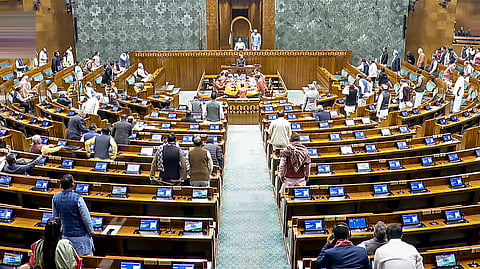

NEW DELHI: At the first meeting of the joint committee of Parliament to examine the Viksit Bharat Shiksha Adhishthan (VBSA) Bill on Thursday, the Opposition members flagged issues such as ‘excess centralisation, institutional autonomy and lack of funding mechanism’ among other issues, said sources.
The Viksit Bharat Shiksha Adhishthan Bill, which was introduced during the Winter session of Parliament, seeks to establish an overarching higher education commission along with three councils for regulation, accreditation and ensuring academic standards for universities and higher education institutions in India. The Bill seeks to establish a single higher education regulator. Facing protests from the Opposition parties, the Bill was later referred to a 31-member joint committee.
According to sources, the panel chairman, BJP MP D Purandeswari, heard the views of the members and assured them that the panel will address the concerns.
Speaking to reporters after the meeting, Purandeswari said, "The committee will go into each of the concerns that have been raised or rather the inputs that have been given... to the committee and we will take all of them onboard."
She said all parties, cutting across their political ideologies, were represented in the meeting, and they contributed by saying whatever they had to on the Bill.
Sources told TNIE that Trinamool Congress (TMC) MPs Saugata Roy and Sagarika Ghose raised concerns of centralisation and highlighted that the bill is silent on the funding mechanism for universities.
“Our concern has been the centralisation of power. Autonomy of institutions are taken away in the bill, and the federal system has gone for a toss,” Saugata Roy told the panel, according to sources.
“It is an incomplete bill, as no mention of the funding.. In this bill, only regulation is mentioned and is silent about the funding,” Roy told the panel.
“Unlike the University Grants Commission (UGC), the proposed VBSA does not have the power to fund higher education institutions,” said another member.
Sources said a few opposition members also expressed their "opposition" to the Bill saying the legislation, if enacted, "will hurt the federal structure" as "too much power has been given to the central government".
According to the bill, the present challenges faced by higher educational institutions due to the multiplicity of regulators having non-harmonised regulatory approval protocols will be done away with. The higher education commission, which will be headed by a chairperson appointed by the President of India, will cover all central universities and colleges under it, institutes of national importance functioning under the administrative purview of the Ministry of Education, including IITs, NITs, IISc, IISERs, IIMs, and IIITs. At present, IITs and IIMs are not regulated by the University Grants Commission (UGC).
The JPC is expected to invite suggestions from stakeholders, including state governments and academic bodies, before finalising its recommendations.
Those who are part of the committee are: Anurag Singh Thakur, Vivek Thakur, Bhartruhari Mahtab, Vamsi Krishna Gaddam, Tejasvi Surya, Sribharat Mathukumilli, Sudhanshu Trivedi, Pradip Kumar Varma, Meenakshi Jain, M Thambidurai, Sagarika Ghosh, Sambit Patra, Hemang Joshi, Sougata Ray, Indra Hang Subba, Digvijaya Singh, E T Mohammed Basheer, Sasmit Patra, Angomcha Bimol Akoijam, Bansuri Swaraj, Brijmohan Agrawal, Lalji Verma, Ram Gopal Yadav, Surendra Singh Nagar, Varsha Gaikwad, Alok Kumar Suman, Anil Desai, Sanjay Kumar Jha, T R Baalu and Shrikant Shinde.
