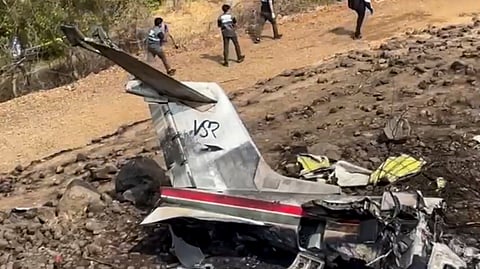

NEW DELHI: The preliminary report into the Baramati air crash has identified non-adherence to Standard Operating Procedures by the aircraft operator, VSR Ventures Pvt Ltd, and the bypassing of prescribed visibility norms at the aerodrome as the key reasons for the accident that killed Maharashtra Deputy Chief Minister Ajit Pawar and four others.
The Aircraft Accident Investigation Bureau (AAIB) on Saturday made public its report on the accident involving VSR Venture's Learjet-45XR aircraft in Baramati on January 28.
Despite poor visibility, the cockpit crew chose to land, and those manning the control gave the go-ahead, the report specified.
The report noted that poor infrastructure and maintenance at the airport also contributed to the crash, pointing out that runway markings guiding pilots during landing had faded as recarpeting was done 11 years ago. The lack of navigational aids beside table top runway 11, where the aircraft VT-VSK crashed, is also responsible. It further stated that the aerodrome did not have a full boundary wall.
The airport lacked navigational aids other than wind socks. “Two windsocks have been installed at the aerodrome, both towards RWY 29 side. No wind sock was available towards runway 11 side,” it said.
The runway markings were almost invisible, it pointed out. “The last runway re-carpeting was carried out in March 2016 and thereafter no runway re-carpeting was carried out which resulted into fading of all the runway markings and presence of loose gravels on the runway surface.” There is no boundary wall around the aerodrome. The available fencing is not adequate and does not cover the entire aerodrome.
The report added that Only Visual Flight Rules (VFR) operations can be carried out at the airport. “However, regular flying training operations and Non-scheduled operations are carried out in the airport,” it pointed out.
The airport did not have an Air Traffic Control (uncontrolled airport). Sharing details of the accident which occurred at 8.46 am in poor visibility conditions, the AAIB said that on the day of the accident, the aircraft was handed over from Pune ATC to Baramati airport when it was 38 miles near it.
The tower at Baramati airfield, managed by Maharashtra Airport Development Company Limited, was manned by a ground instructor of a Flight Training Organisation (FTO). He was communicating with the aircraft to assist the landing. “The crew of VT-SSK asked for visibility while approaching Baramati for which the tower replied as 3000 meters by looking at the visibility markers. Further, while giving the landing clearance, the tower informed winds as calm. Hence, the visibility reported at Baramati at the time of landing of aircraft was well below the minima required for VFR flight which is 5000 meters (5 Km),” it said.
However, the aircraft continued its approach and subsequently carried out a go-around. “During the second approach, the aircraft reported field in sight, and subsequently landing clearance was given by the Baramati tower for runway 11. The tower also informed the winds as calm. Later, the aircraft was heard transmitting “Oh S**t… Oh S**t…”, before it crash landed on the left side of the runway 11 threshold,” the report explained.
The aircraft was attempting to land on runway 11 after obtaining landing clearance by Baramati tower. The aircraft, however, crash landed on the left of the runway abeam the threshold of the runway.
“As per the CCTV footage installed in the nearby village, the aircraft was observed to have banked towards right before impacting the terrain. The aircraft first impacted the trees before hitting the ground which is at a lower elevation than the runway surface. The ground impact of aircraft was at a lateral distance of about 50 meters on the left from edge of RWY 11,” it said.
The aircraft was engulfed in fire, during which the entire cockpit and cabin section was burnt and destroyed. Both the Solid-State Flight Data Recorders (SSFDR) and Solid-State Cockpit Voice Recorder (SSCVR) suffered thermal damage and required special recovery and analysis.
The AAIB, in its report, has recommended that the aviation regulator DGCA may issue necessary directions to all operators flying VFR to uncontrolled airfields to strictly adhere to the laid-down standard operating procedures.
The report also recommended that DGCA issue directions to all the aerodrome operators at uncontrolled airfields to ensure that flying operations are allowed only when the meteorological conditions are within the criteria laid down in its regulations.
DGCA needs to enhance the landing aids along with basic MET facility at these airports to cater for large number of Non-Scheduled/chartered flying (including VIP flights). It needs to check the feasibility of licensing these aerodromes for conduct of safe and regulated flying operations, the report said.
