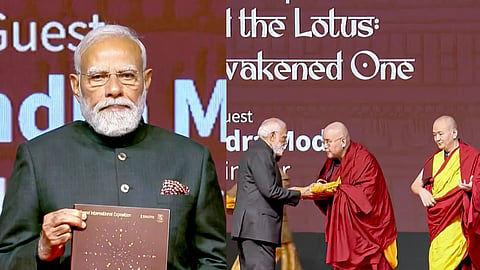

NEW DELHI: Sacred ancient gems linked to the Buddha were unveiled on Saturday in Delhi for the first time since their colonial-era removal.
The Piprahwa gems, a collection of more than 300 precious stones and ornaments believed to have been buried with relics of the Buddha at a stupa site in northern India, were formally displayed at an exhibition in New Delhi.
"This historic event marks the reunification of the Piprahwa gem relics of Lord Buddha, repatriated after 127 years," the Ministry of Culture said in a statement.
It said that they are on display "for the first time" since British excavations in 1898 unearthed them and they were subsequently scattered across the world.
Prime Minister Narendra Modi, who opened the exhibition, said it was a "very special day for those passionate about history, culture and the ideals" of the Buddha.
The Buddha -- who renounced material wealth to embrace and preach a life of non-attachment -- founded a religion that now has more than 500 million adherents.
Born in what is now Nepal, he spent much of his life in northern India.
"For India, the sacred relics of Bhagwan Buddha are not merely artefacts, they are a part of our revered heritage and an inseparable part of our civilisation," the prime minister said at the event here in the presence of Buddhist scholars, diplomats and other guests.
After a wait of one and a quarter centuries, he said, India's heritage has returned, and India's sacred legacy has come back home.
The wisdom and path shown by Bhagwan Buddha belong to all of humanity, he said.
Modi also thanked the Godrej Group for ensuring that the relics of Buddha return to his homeland.
'Shared heritage of humanity'
The gems, believed to date back to around 200 BC, were unearthed in 1898 by British colonial engineer William Claxton Peppe in Piprahwa, in Uttar Pradesh state.
Indian authorities said an inscription on one of the caskets unearthed with the treasure confirmed the contents -- which include bone fragments -- as "relics of the Buddha".
While the majority were handed over to colonial authorities and some were housed in the Indian Museum in Kolkata, Peppe kept a treasure trove of jewels.
In May 2025, Peppe's great-grandson, Chris Peppe, put the gems up for sale.
They were listed for auction by Sotheby's in Hong Kong, with a starting bid of $1.2 million, with experts suggesting they could have made ten times that.
But the auction was cancelled after the Indian Ministry of Culture issued a legal order calling the jewels the "inalienable religious and cultural heritage of India and the global Buddhist community".
The gems were then bought by an Indian conglomerate, Godrej Industries Group, in partnership with India's government. The sale price was not disclosed.
"The Piprahwa gems are not just artefacts," company vice-chairman Pirojsha Godrej, said in a statement at the time.
"They are timeless symbols of peace, compassion, and the shared heritage of humanity."
Chris Peppe has said his family was happy that the "gems will be available for the public" to see.
The exhibition in New Delhi brings together the recently returned jewels, other treasures stored in Kolkata and relics from later excavations in the 1970s.
Hindu-nationalist leader Modi has in the past loaned parts of the Piprahwa collection for brief exhibitions to places with major Buddhist populations, including Russia's Kalmykia region and neighbouring Bhutan.
India's Ministry of Culture said the return of the gems was part of Modi's "broader mission to reclaim and celebrate Bharat's (India's) ancient cultural and spiritual heritage from across the world".
(With inputs from PTI)
