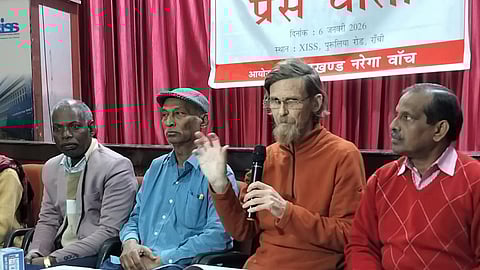

RANCHI: Social economist Jean Drèze has cautioned that the proposed VB-G RAM G scheme contains no substantive provisions to improve workers’ conditions and effectively dismantles the employment guarantee enshrined in MGNREGA.
Speaking to the media in Ranchi, Drèze said the scheme goes far beyond a mere change of name and, in effect, repeals the Mahatma Gandhi Rural Employment Guarantee Act (MGNREGA), stripping it of its core principle, the guarantee of employment, and reducing it to a hollow framework.
“Not only has the name been changed, but the entire MGNREGA has been repealed through this scheme, which clearly states that ‘The Mahatma Gandhi Rural Employment Guarantee Act (MGNREGA), together with all rules, notifications, orders and guidelines, stands repealed.’ In its place, a new scheme, the VB-G RAM G scheme, is being introduced,” Drèze said.
He pointed out that the new programme is a completely centrally sponsored scheme in which all key decisions will be taken by the Union government. “There is no obligation on the Centre. Whatever liability exists is shifted to the state governments,” he added.
According to Drèze, the employment guarantee is being weakened through at least five key provisions in the new scheme.
“The first is what I call the ‘switch-off clause’. The scheme will be implemented only at times and in places notified by the central government. This means there is no guarantee of employment, as work will be provided only when the government decides,” he said.
Secondly, he highlighted a new financial framework. Under MGNREGA, nearly 90 per cent of the funding was provided by the central government, ensuring timely wage payments as the Centre has greater fiscal capacity. Under the proposed framework, however, the Centre will decide state-wise normative allocations.
“Sixty per cent of the funds will be provided by the Centre and 40 per cent by the states, significantly increasing the financial burden on state governments,” Drèze said.
He further noted that the Bill grants the Centre discretionary powers over allocations. “Beyond the allocated amount, states will be required to bear 100 per cent of the cost,” he added.
The third provision, Drèze said, relates to the introduction of mandatory ‘discontinuation periods’, under which state governments will have to specify up to 60 days during which no employment will be provided.
Fourth, he pointed out that all works under the scheme will have to be carried out through convergence with other schemes notified by the central government, leaving little autonomy to states in deciding the nature of works.
The fifth concern, according to Drèze, is excessive reliance on technology. “The new scheme repeatedly emphasises digital systems, biometrics and even artificial intelligence, the word ‘digital’ appears as many as 35 times,” he said.
“The experience of the past decade shows that such technologies are not required for an employment guarantee scheme. In fact, their use has often led to exclusion and losses under MGNREGA,” he added.
Drèze argued that the proposed scheme offers no real guarantees, neither of implementation, nor of financial allocation, nor of employment. He also dismissed the promise of 125 days of employment as “nothing but an eyewash”.
Meanwhile, Jharkhand MGNREGA Watch has announced a ‘VB-GRAMG Hatao’ rally in Ranchi on February 2, coinciding with MGNREGA Day. At least 5,000 daily wage workers are expected to participate in the protest.