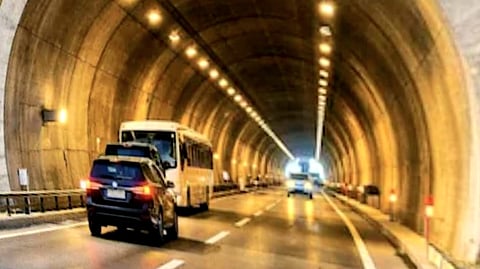

DEHRADUN: In a major infrastructure push aimed at improving safety and sharply reducing travel time for the growing number of Kedarnath pilgrims, the Central Government is fast-tracking plans to construct a new 7-kilometre tunnel in Uttarakhand, supplementing the recently approved ropeway project.
The ambitious proposal is designed to enhance road connectivity between the Kali Math Valley region and Sonprayag, the staging point for the Kedarnath ropeway, ensuring safer and more reliable access even during adverse weather conditions.
According to sources, the tunnel will follow a twin-tube design, with one tube carrying regular traffic and the second reserved exclusively for emergency evacuation. The configuration directly addresses safety concerns highlighted by recent incidents in the region.
“The twin-tube configuration is essential,” said Colonel Deepak Patil (Veteran), who played a key role in the Silkyara tunnel rescue operation. Speaking exclusively to TNIE, Col Patil welcomed the initiative but emphasised the need for rigorous geological planning.
“It is a good idea to construct this highway tunnel, but lessons from Silkyara must be applied. The primary focus should be on preparing a robust Detailed Project Report (DPR), incorporating comprehensive geological data of the terrain through which the tunnel is proposed,” he said.
Col Patil further advised that the tunnel alignment should prioritise stable rock mass, even if this results in a longer route.
The infrastructure upgrade has been prompted by a sharp rise in pilgrimage numbers. Last year, around 17.7 lakh devotees visited Kedarnath. Projections suggest this figure could reach 25 lakh by 2030 and nearly 40 lakh by 2040.
The proposed tunnel will connect Chamasi to Sonprayag. Authorities are also exploring options for a dedicated pedestrian pathway and a separate foot tunnel towards Chamasi to improve last-mile connectivity for pilgrims undertaking the final ascent. At present, all vehicular movement relies on the single-lane NH-107 up to Sonprayag and Gaurikund. Plans are also underway to widen the existing Kali Math Valley road to two lanes to accommodate future traffic volumes.
Acknowledging the fragile Himalayan geology, the Uttarakhand government has assured that extensive geological and hydrological studies will be carried out before construction begins, drawing crucial lessons from the Silkyara tunnel incident.
Reiterating the importance of safety-focused design, Col Patil said, “The second most critical requirement is a twin-tube tunnel, which allows emergency escape both during construction and operation.” He noted that European standards favour separate tubes for one-way traffic to reduce the risk of head-on collisions and minimise casualties caused by fire and toxic smoke.
Once completed, the new tunnel, together with the 12.9-km ropeway project being developed by Adani Enterprises, expected to be operational by 2031–32 and reduce travel time to around 40 minutes, is set to transform the Kedarnath Yatra experience over the next decade.