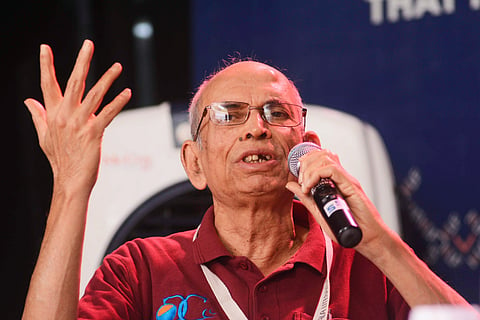

BENGALURU: Padma Awardee and eminent ecologist Prof Madhav Gadgil breathed his last late Wednesday night in Pune. He was suffering from multiple age-related ailments.
He was well known for the voice he raised on multiple platforms for the protection of the pristine Western Ghats, covering the landscape of Maharashtra, Goa, Karnataka, Kerala and Tamil Nadu, while putting forest dwellers and tribes at the centre of forest and environment protection.
Born on May 24, 1942, the Indian ecologist and academician scaled many heights. He was the founder of the Centre for Ecological Sciences at the Indian Institute of Science (IISc), Bengaluru, and headed the Western Ghats Ecology Expert Panel (WGEEP) in 2010 – popularly known as the Gadgil Commission. He had prepared a detailed report on the protection of the Western Ghats, describing the zones and the developmental activities that could be permitted and the ones that could not.
The Prof Gadgil-led WGEEP recommended that the entire Western Ghats be designated as an “ecologically sensitive area”. Based on how ecologically sensitive Western Ghats are, the WGEEP divided it into three zones, Ecologically Sensitive Zone (ESZ)-1, ESZ-2 and ESZ-3, strictly prohibiting dams, mining and major infrastructure in ESZ-1. It sought sustainable agricultural practices, while recommending ban on plastic bags, genetically modified crops The WGEEP sought a bottom-up, decentralized system and large scale monocultures.
However, the recommendations appeared too stringent for the southern states, which shelved the WGEEP 2010 report and constituted the Kasturirangan Committee.
Prof Gadgil’s son, Siddhartha Gadgil, who is a faculty member at IISc, told The New Indian Express, “He suffered from lung infection for some time. Last month, he had a fall and suffered injuries to his hip for which he underwent hip replacement.
He had also suffered a brain haemorrhage. He suffered from pneumonia and then a septic shock, which affected his blood stream. He breathed his last at around 11pm on Wednesday night. He was in the hospital for the last eight days.”
Prof Gadgil’s close associates who worked with him in Pune and in Karnataka forest and ecology departments said he was passionate about the subjects and topics he covered. Although he was known to have a bad temper, his arguments were always right and they could not be denied, they said.
“There were instances wherein arguments happened, but they were meant for the cause of environmental protection. He was critical of the forest department, which was needed for better delivery of services. He was keen that forest departments across the Western Ghats engaged with the communities and were not just tasked with planning,” said retired Principal Chief Conservator of Forests, Karnataka, Brij Kishore Singh.
Prof Gadgil was a former member of the Scientific Advisory Council to the Prime Minister and the architect of the Biodiversity Act, playing a key role in the creation and implementation of the Forest Rights Act. He earned laurels for publishing over 250 scientific papers on various ecological and academic projects.
He received the Volvo Environment Prize in 2003 recognising his outstanding scientific achievements contributing to environmental stewardship and sustainability, and the Tyler Prize for Environmental Achievement (called the “Nobel for the environment”) in 2015 by University of Southern California, recognising his contributions to environmental science. He was also a member of the National Tiger Conservation Authority (NTCA) and the National Council of Educational Research & Training (NCERT).
He received the Padma Shri award in 1981 and the Padma Bhushan in 2006. He was conferred United Nation’s highest environmental honour, the Champions of the Earth Award, in 2024, and the Georgescu-Roegen Award in 2014.
The list of awards also included the Harvard Centennial Medal in 2002, Vikram Sarabhai Award in 1990, Shanti Swarup Bhatnagar Prize for Science and Technology in 1986, and Rajyotsava Prashasthi in 1983.
He was honoured with National Environmental Fellow from 1979-81and the IBM Fellow Harvard Computing Centre from 1968-69. Gadgil was born in Pune, where he completed his basic education and then moved to Mumbai (then Bombay) for his MSc before moving to Harvard University for his PhD. He was well-known for the extensive work he did on population biology, conservation biology, human ecology and ecological history. His works have been translated into many Indian languages for wider understanding of the topics he wrote on.
HE WOULD LET US DO OUR RESEARCH: SUKUMAR
Working with Prof Madhav Gadgil in the lab or on the field was always a learning experience, said Raman Sukumar, elephant expert and faculty member at the Centre for Ecological Sciences, Indian Institute of Science. He was one of the first three students who did their PhD under Prof Gadgil at the Centre for Ecological Sciences in 1979. Prof Gadgil had joined IISc in 1973 and retired in 2004. He helped many students till his last day of working, said Sukumar.
Gadgil had formed the centre in 1983. It was the first Centre of Excellence of the Environment Ministry. It was formed out of the ecological research initiated at the Centre for Theoretical Studies in 1973. “He was not strict. I did most of my work in the field and I remember him visiting me in Satyamangala and BR Hills. I also gave him insights on the wildlife terrains and elephants.
I helped in the Nilgiri Biosphere document that Prof Gadgil prepared,” Sukumar said, while recollecting how he submitted his PhD report of around 700 pages to Gadgil. “Prof Gadgil told me he will take around two weeks to read it. But he read and gave his comments within a couple of days. He had read the entire handwritten report,” Sukumar said. Sukumar said Prof Gadgil promoted protection of biosphere reserves stressing upon the need for people’s participation.
