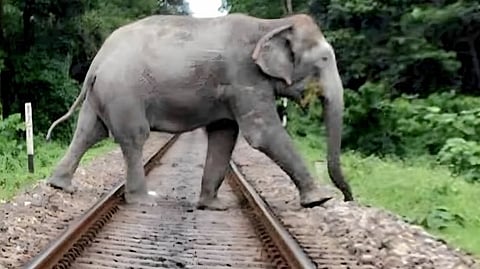

DEHRADUN: The majestic elephants of Uttarakhand are facing a grim reality, with alarming fatality rates continuing unabated across the state. Despite previous dips, elephant deaths have surged again in 2025, raising serious concerns among wildlife authorities who are struggling to understand the growing trend of these animals venturing into human settlements.
Official sources confirm that over two dozen elephants have died in 2025 alone. These fatalities are not solely due to train accidents but increasingly involve electrocution.
Data compiled over the last quarter-century shows that 540 elephants have died in Uttarakhand over the past 25 years, with 168 deaths attributed to unnatural causes. Of these, 54 involved electrocution, while 33 elephants were killed by speeding trains.
The recent trend reveals fluctuating but persistently high mortality rates. While 2023 saw a peak of 34 deaths, the number dropped to 18 in 2024. However, 2025 has seen a renewed spike, recording 30 fatalities.
The primary threat remains the railway tracks intersecting elephant corridors, leading to fatal collisions. However, electrocution due to illegal or poorly maintained wiring is emerging as an equally significant menace. Infighting among herds also contributes to the toll.
The Forest Department is particularly perplexed by the escalating ingress of elephants into urban and semi-urban areas. Officials believe the elephants’ highly developed sense of smell is driving them toward food sources available in human habitations. Haridwar district frequently reports incidents of elephants raiding main markets and residential colonies.
"We are in constant coordination with the Railway department to prevent accidents on train tracks, employing multi-level mitigation efforts," stated RK Mishra, Principal Chief Conservator of Forests. "Furthermore, strict action is being taken in cases of electrocution, and we are actively working on solutions."
Rajiv Talwar, Honorary Warden of Rajaji Tiger Reserve, told TNIE that while elephants have historically approached human areas, "the problem has intensified significantly now." "The rising number of electrocution deaths requires an in-depth look," Talwar noted. "These increasing incidents signal that the time for serious study and concrete solutions regarding their urban migration is now."
In response to this behavioral shift—akin to the recent aggression seen in Himalayan black bears—the Uttarakhand Forest Department has decided to collaborate with the Wildlife Institute of India (WII). Experts are set to commence fieldwork soon to scientifically investigate the root causes behind the elephants' increasing attraction toward urban landscapes.
