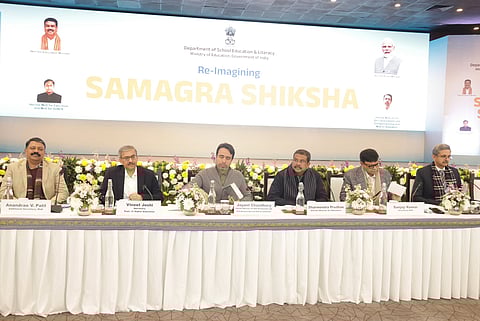

NEW DELHI: Union Education Minister Dharmendra Pradhan on Friday called for entrusting the responsibility of schools back to society to ensure the holistic development of students.
With the second phase of Samagra Shiksha (Integrated Education) set to conclude by March 31 this year, the Ministry of Education has embarked on the task of readying a roadmap for Samagra Shiksha 3.0.
"The government must take responsibility for systems and salaries. But the responsibility of running schools should belong to society. As we move towards a new framework of Samagra Shiksha, we must collectively think about how to make this possible and restore schools as vibrant institutions rooted in society," Pradhan told participants at a meeting on Friday on Samagra Shiksha.
To promote the holistic development of students and expand access to knowledge through the meaningful integration of technology, it is essential to once again entrust schools to society, he stressed.
The day-long consultative meet at Sushma Swaraj Bhavan -- 'Reimagining Samgra Shiksha' -- was chaired by Pradhan with all stakeholders, including State Project Directors from 11 States and Union Territories, taking part. Samagra Shiksha is an integrated, centrally sponsored scheme for school education covering the entire continuum from pre-primary to senior secondary level without segmentation. It was launched on April 1, 2018.
"The meeting aimed to develop a strategic, consultative, and implementable roadmap for Samagra Shiksha 3.0 through collaborative deliberations with States, UTs, and sectoral stakeholders. The discussions focused on emerging challenges, best practices, and priority interventions required to strengthen governance, infrastructure, teacher training, and student entitlements in the next phase of the scheme," said an official release.
Pradhan said that Viksit Bharat by 2047 can be realised only when every child in the country has access to quality education and the country achieves 100 per cent enrolment up to Class XII. "Bridging learning gaps, reducing dropouts, improving learning and nutrition outcomes, strengthening teacher capacity and fostering critical skills are collective responsibilities for building a strong human capital base," he said.
Jayant Chaudhary, Minister of State for Education, said Samagra Shiksha 3.0 is the larger, operational expression of the National Education Policy where schools act as agents of change. "By embedding skilling, vocational pathways, digital learning and inclusion within a multidisciplinary education framework, Samagra Shiksha moves beyond reform to prepare students for work, life and a rapidly changing economy," he said.
Secretary of School Education and Literacy department, Sanjay Kumar, emphasised the importance of age-appropriate learning, and highlighted the need for curriculum equivalence across different state boards. “Technology, particularly Artificial Intelligence, must be leveraged by interweaving it into the curriculum and integrating it as a key component of Samagra Shiksha,” he said.