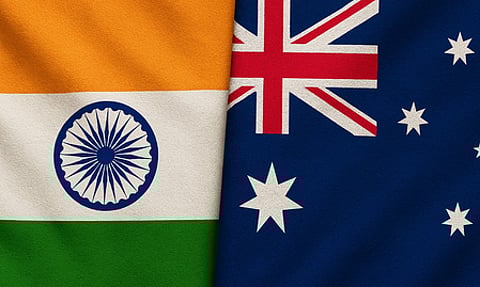

NEW DELHI: Australia has placed Indian students in the highest risk category under its student visa system, tightening scrutiny of applications from January 8. Under the move, India has been classified under Evidence Level 3 of Australia’s Simplified Student Visa Framework, alongside Bhutan, Bangladesh and Nepal. This means Indian applicants will now face stricter checks on English language proficiency and documents submitted to prove financial capacity.
While Australian authorities have not officially stated the reasons, it is understood that a rise in fraudulent practices, including the use of fake academic certificates and inflated or false bank balance documents, has led to the decision. With this change, Australia joins countries such as the United States, the United Kingdom and Canada, which have recently tightened rules for international students and post-study work visas.
The move has surprised education experts, especially as Australia’s neighbour New Zealand liberalised norms for Indian students and professionals only last month following a new Free Trade Agreement with India. Under those changes, Indian students pursuing degree programmes were offered a two-year work visa, Bachelor’s (Honours) degree holders a three-year work visa, and 5,000 Indian professionals across disciplines were assured work visas.
Academicians in India said they were unable to comprehend Australia’s decision, given the strong education ties between the two countries. More than 1.4 lakh Indian students studied in Australia in 2025, and a high-level Australian delegation visited India last month to expand education partnerships.
Reacting to the development, Mamidala Jagadeesh Kumar, former Chairman of the University Grants Commission and former Vice Chancellor of Jawaharlal Nehru University, said, “India and Australia share a strong education partnership built on trust. Australia’s updated visa scrutiny seeks to protect program integrity and support genuine learners. This support will help Indian students to apply early, submit complete documents, and choose accredited institutions.”
Kumar also pointed out that several Australian universities are keen to establish campuses in India. The UGC has already approved proposals from the University of Western Australia in Chennai, the University of Western Australia in Mumbai, Victoria University in Gurugram, Western Sydney University in Greater Noida, La Trobe University in Bengaluru, and the University of New South Wales in Bengaluru.
A senior educationist said the development needed to be viewed in the context of global geopolitics. “It needs to be viewed in light of the geo-politics taking place. A narrative is being built against India in the US. While Indians were formerly viewed as bright and valued professionals, negative aspects are continuously being publicized now,” he said.
He added that the growing interest of foreign universities in setting up campuses in India could also be linked to this trend. “They want Indian students and their money but do not want them inside their country too,” he said.
India’s Higher Education Secretary did not respond to queries on the issue. The response of the ministry has also been sought.