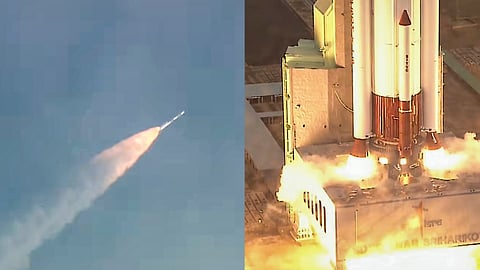

BENGALURU: The scientific community’s hopes of a smooth PSLV comeback were dashed on Monday, January 12, 2026, as the PSLV-C62 mission suffered a major setback.
ISRO Chairman V Narayanan said: “PSLV-C62 was launched as scheduled, and everything proceeded as planned until the third stage separation. Disturbances were observed at the end of the third stage. The flight path deviated from the plan. We are analysing the data.”
The launch took place at 10:18 am from the first launch pad of the Satish Dhawan Space Centre in Sriharikotta. This was the first satellite launch of 2026, with ISRO aiming to restore confidence in the PSLV, often referred to as the organisation’s workhorse. It follows the PSLV-C61 setback in May 2025, which experienced a technical glitch in the third stage due to changes in chamber pressure.
Ahead of the launch, Chairman V Narayanan had visited Tirupati Temple on Saturday.
The PSLV-C62 was carrying the EOS-N1, also known as Anvesha, an advanced Earth observation satellite developed by the Defence Research and Development Organisation (DRDO). The satellite is intended for strategic defence purposes as well as civilian applications such as agriculture, urban mapping, and environmental monitoring.
This marked the 64th PSLV flight and the fifth mission of the PSLV-DL variant. ISRO had also aimed to celebrate its 101st orbital launch with this mission. The rocket had a lift-off mass of 260 tonnes, stood 44.4 metres tall, and was scheduled to reach an altitude of 505.291 km.
In addition to EOS-N1, the mission carried 15 co-passenger satellites from commercial and international agencies, including a demonstration of the Kestrel Initial Technology Demonstrator (KID) from a Spanish startup. KID is a small-scale prototype of a re-entry vehicle, planned for splashdown in the South Pacific Ocean following deployment.
The mission plan involved placing EOS-N1 and 14 co-passenger satellites into a Sun-synchronous orbit, while the fourth stage would de-boost the KID capsule into a re-entry trajectory. The PSLV has a legacy of 63 successful flights, including Chandrayaan-1, Mars Orbiter Mission, Aditya-L1, and Astrosat, and in 2017 set a world record by deploying 104 satellites in a single mission.
This second consecutive setback underscores the challenges of complex space missions, even for ISRO’s most reliable launch vehicle.
