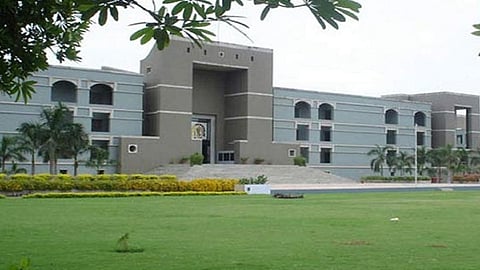

AHMEDABAD: The Gujarat High Court on Tuesday dismissed the petitions by AAP leaders Arvind Kejriwal and Sanjay Singh challenging a lower court order in the Gujarat University defamation case.
The case is linked to their 2023 remarks on Prime Minister Narendra Modi’s academic degree, clearing the way for the criminal trial to continue.
A single judge bench of Justice MR Mengdey rejected their demand for separate trials, upholding the lower court orders.
The High Court had reserved its verdict after hearing arguments from both sides
The pleas challenged decisions of the trial court and Ahmedabad City Sessions Court, which had earlier refused to grant relief to the two AAP leaders. With the ruling, criminal defamation proceedings over remarks on PM Modi’s degree will continue jointly.
The case traces its origin to a criminal defamation complaint filed by Gujarat University in April 2023, following sharp public remarks made by Kejriwal and Singh during a press conference questioning Prime Minister Narendra Modi’s educational qualifications.
The university alleged that the statements were “highly insulting” and had caused serious damage to its long-standing academic reputation.
The controversial remarks were made within weeks of the Gujarat High Court quashing a Central Information Commission (CIC) order that had directed disclosure of the Prime Minister’s MA degree, a timing the university cited to underline the alleged intent and impact of the statements.
The duo had sought separate trials on various grounds.
As the criminal defamation case proceeded before an Ahmedabad Magistrate’s Court, Kejriwal filed an application requesting that his trial be separated from that of Sanjay Singh, arguing that there was no allegation of conspiracy or common criminal intention that justified a joint trial.
The Magistrate’s Court rejected this plea, a decision that was later upheld by the Sessions Court and now by the High Court.
Parallelly, Sanjay Singh mounted a separate legal challenge focused on procedural grounds. Acting through his lawyers, Singh objected to the Magistrate Court recording his plea under Section 251 of the Criminal Procedure Code (CrPC) in the presence of his counsel.
Maintaining his innocence, he argued that the plea recording was invalid and sought the quashing of the order. This contention too failed to find favour with the courts.
