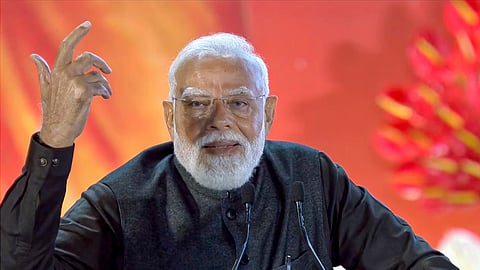

NEW DELHI: Prime Minister Narendra Modi addressed the concluding session of the Viksit Bharat Young Leaders Dialogue 2026 on Monday, reflecting on the long passage of time since he first assumed public office. He remarked that when he took the oath as Chief Minister, many of today’s young citizens were not born, and when he became Prime Minister in 2014, most of them were still children.
Despite this, he said that his faith in the younger generation has remained constant and unwavering. “Your capability, your talent, I have always drawn energy from your energy. And look at today, all of you are holding the reins of the goal of a Developed India”, Modi said.
He underlined that the years leading up to 2047, when India completes 100 years of independence, represent a decisive phase for both the nation and its youth. According to him, the strength and abilities of young Indians will determine the country’s strength, and their success will take India to new heights. Congratulating the participants of the Viksit Bharat Young Leaders Dialogue, the Prime Minister emphasised the central role of youth leadership in realising the vision of a developed India.
Modi noted that the dialogue coincided with the birth anniversary of Swami Vivekananda. “Remembering Swami Vivekananda, we celebrate National Youth Day every year on 12 January. Inspired by his ideals, 12 January has been chosen for the Viksit Bharat Young Leaders Dialogue. The life of Swami Vivekananda is a great guiding light for all of us”, he said.
Expressing satisfaction over the rapid expansion of the Viksit Bharat Young Leaders Dialogue, the Prime Minister described it as a powerful platform that enables direct participation of youth in shaping India’s development agenda. “The association of crores of young people with this initiative, more than 5 million registrations, over 3 million youths participating in the Viksit Bharat Challenge, and sharing their ideas for the nation’s development, such large-scale engagement of youth power is unprecedented”, Modi observed.
He praised the quality of ideas presented, particularly on themes such as Women-Led Development and Youth Participation in Democracy. Referring to the presentations made during the dialogue, he said they reflected the strong resolve of India’s Amrit Peedhi to build a developed nation. He also highlighted the creativity and innovative spirit of India’s Gen Z, congratulating all young participants and members of the Mera Yuva Bharat organisation for the successful conduct of the programme.
Recalling the period before 2014, the Prime Minister described it as an era marked by policy paralysis, excessive red tape and limited opportunities for young people. He said that youth at that time had to deal with cumbersome procedures for jobs, examinations and starting businesses, along with delays in decision-making and poor policy implementation. He added that many practices which now appear unacceptable were routine a decade ago, and noted how governance reforms have since transformed the experience of India’s youth.
As an example, Modi referred to the startup ecosystem, pointing out that despite global growth in startup culture over several decades, India had very little focus on startups before 2014. “Until 2014, there were fewer than 500 registered startups in the country. In the absence of a startup culture, government intervention dominated every sector. Our youth talent, their capabilities, did not get the opportunity to fulfill their dreams”, he said.
The Prime Minister explained that his confidence in the abilities of India’s youth led to a new development approach centred on empowering young innovators. He highlighted major reforms and initiatives such as Startup India, Digital India, Ease of Doing Business, and the simplification of tax and compliance systems, which he said accelerated India’s startup revolution by opening up sectors that were previously dominated by the government.
Referring to the space sector, Modi said, “Until 5–6 years ago, the responsibility of advancing the space sector rested solely with ISRO. We opened the space sector to private enterprise, created supporting frameworks and institutions.” He noted that this move has resulted in the emergence of more than 300 startups, citing the achievements of Skyroot Aerospace and Agnikul Cosmos as examples of how youth-led innovation is positioning India as a global leader in emerging technologies.
He also spoke about reforms in the drone sector, which was previously constrained by complex regulations and licensing requirements. According to him, simplified rules enabled rapid youth-led growth in drone technology, benefiting areas such as national security and agriculture through Made-in-India drones and initiatives like the Namo Drone Didis.
The Prime Minister further highlighted reforms in the defence sector, which had long been dominated by public enterprises. “Today, more than 1,000 defence startups are operating in India. One young person is building drones, another is developing anti-drone systems, someone is creating AI-powered cameras, while others are working in robotics,” Modi said.
He drew attention to the impact of the Digital India initiative in nurturing a new generation of creators and driving the growth of India’s Orange Economy, focused on culture, content and creativity. “India is witnessing unprecedented growth in the ‘Orange Economy’, that is, culture, content, and creativity. India is emerging as a major global hub in areas such as media, film, gaming, music, digital content, and VR-XR”, Modi noted.
He added that the World Audio-Visual and Entertainment Summit (WAVES) has emerged as an important launch platform for young creators. “In other words, no matter the sector, the doors of limitless opportunities are opening in India today,” he said, encouraging youth to pursue their ideas fearlessly and assuring them of continued government support.
The Prime Minister stated that the reform agenda of the past decade is gaining further momentum, with youth at its centre. He highlighted next-generation GST reforms and tax relief up to Rs 12 lakh as steps that simplify procedures and increase savings for young professionals and entrepreneurs. Emphasising the growing demand for energy driven by artificial intelligence and advanced manufacturing, he referred to reforms in civil nuclear energy, including the SHANTI Act, which aim to ensure reliable power supply, create large-scale employment and generate positive spillover effects across the economy.
Modi also referred to global shortages in the workforce and stressed India’s efforts to prepare its youth for international opportunities. “Our effort is to ensure that India’s youth are prepared for the opportunities emerging across the world. Therefore, continuous reforms are being carried out in sectors related to skill development”, he said.
He reiterated that following the introduction of the new National Education Policy, regulations governing higher education are being reformed. “Foreign universities are also opening their campuses in India. Recently, the PM SETU Programme was launched with investments worth thousands of crores of rupees. Under this, thousands of ITIs will be upgraded so that youth can be trained in line with the current and future needs of industry”, Modi noted.
The Prime Minister stressed that self-confidence is fundamental to a self-reliant and developed nation. Referring to Macaulay’s colonial-era education policies, he said they had fostered a sense of inferiority among Indians towards their own heritage, products and capabilities. Calling on the youth to overcome this mindset, he said, “In ten years, it will mark 200 years since Macaulay’s audacious policies, and therefore, every young person in the country must resolve to free India from this mentality.”
He highlighted the importance of being open to global knowledge while valuing India’s own traditions, quoting the Vedic phrase “Aano Bhadrāh Kratavo Yantu Vishwatah”, meaning let auspicious and noble thoughts come from all directions. “You must learn from the best practices around the world, but never let the tendency to undervalue your own heritage and ideas dominate”, Modi said.
Citing Swami Vivekananda as an example of embracing global ideas while challenging misconceptions about India, the Prime Minister encouraged the youth to move forward with energy, maintain fitness and embrace joy.