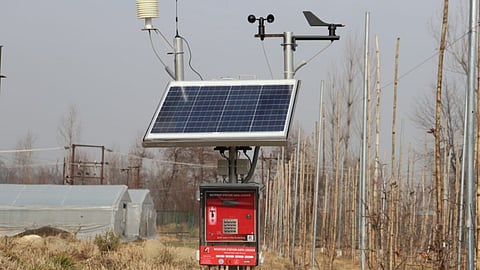

NEW DELHI: To enhance the precision of weather forecasts at a hyper-local level in metropolitan areas, the Union Government has announced the deployment of 200 Automatic Weather Stations (AWS) across Delhi, Mumbai, Chennai, and Pune in 2026 under Mission Mausam Phase II.
By the end of this year, the government plans to add 50 AWS in each of the selected metropolitan cities. This initiative will enable these cities to receive real-time weather forecasting and improve disaster preparedness, particularly in densely populated urban regions. Currently, India has a total of 1,000 AWS.
Delhi currently has 18 operational AWS, which are insufficient given the city’s geography and dense population. To address this, the government will add 50 new AWS in 2026, alongside existing departmental observatories, to enhance hyper-local weather forecasting. Of the 50 new AWS, 20 will be installed by the end of this month.Union Minister of State for Science & Technology and Earth Sciences, Jitendra Singh, announced the expansion of India’s urban weather observation infrastructure on the 151st anniversary of the India Meteorological Department (IMD).
M Ravichandran, Secretary of Science and Technology and Earth Sciences, stated, “We are urging other countries to upgrade their ocean observation systems so that we can obtain diverse data rather than depending on just one country.” Currently, the US provides 50 per cent of ocean observations to India.
The credibility of the IMD’s forecasts has increased significantly over the past decade. “This has led to an unprecedented demand for its services,” added Ravichandran.
Highlighting the transformation in India’s weather forecasting capabilities, Mrutyunjay Mohapatra, Director General of IMD, noted a significant rise in forecast accuracy.
“Weather forecasts have improved by more than 40 to 50 per cent compared to earlier decades. Cyclone tracking accuracy has increased by nearly 35 to 40 per cent, while errors in monthly and seasonal forecasts have reduced sharply from around 7.5 per cent to nearly 2.5 per cent,” said Mohapatra. He attributed these improvements to sustained investment, technological advancements, and institutional support over the last decade.
