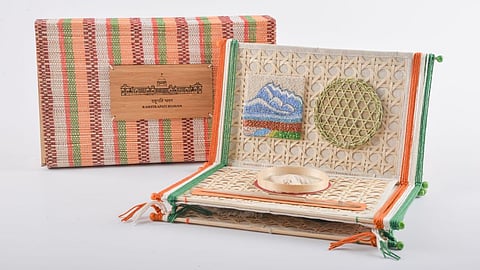

AHMEDABAD: Ahead of India’s 77th Republic Day, Rashtrapati Bhavan’s prestigious ‘At Home’ invitation kit has turned into a canvas of the North-East.
Designed by the National Institute of Design (NID) in Ahmedabad, the kit brings together the handicrafts, culture, and living traditions of the eight ‘Ashtalakshmi’ states, celebrating swadeshi spirit, self-reliance, and artisan-led design.
The invitation kit was designed for the ‘At Home’ ceremony at Rashtrapati Bhavan, held on the eve of the country’s 77th Republic Day.
Explaining the significance of the project, Ashok Mondal, Director of NID Ahmedabad, said the institute had been entrusted with the task for the third consecutive time. He described it as a moment of pride for the entire institution.
He said the project presents the traditional crafts and cultural identity of all eight North-Eastern states – Arunachal Pradesh, Assam, Manipur, Meghalaya, Mizoram, Nagaland, Sikkim, and Tripura – brought together under a single, cohesive design narrative.
He underlined that the invitation kit is the result of three months of sustained effort. During this period, the NID team held extensive discussions, carried out research, and worked closely with artisan communities across the North-East, while simultaneously being in consultation with the Rashtrapati Bhavan team.

Every artwork, he said, was specially designed with careful attention to the seasonal availability of raw materials and the distinct handicraft traditions of each state.
Each artefact reflects not just regional aesthetics but also the skill of the artisans, the natural ecosystems that sustain their crafts and their relevance in a modern cultural context, the institute noted.
In total, more than 350 artisans, including many from the North-Eastern states, contributed to the making of the invitation kits.
The project was led by Prof. Andrea Noronha and Prof. Dr C.S. Susanth of NID Ahmedabad, with active support from NID’s faculty members, students and technical staff.
The initiative also marked a strong inter-campus collaboration, bringing together NID teams from Ahmedabad and Bengaluru, alongside skilled artisans working from their own villages, reinforcing community participation and collective creativity.
At the heart of the kit is the invitation box, crafted from bamboo mats woven on a loom using Tripura’s traditional techniques.
Bamboo, the backbone of the North-East’s economy and cultural life, has been used extensively, along with dyed cotton threads and fine bamboo strips.
The outer cover is adorned with handmade paper and smoked bamboo ornaments from Meghalaya, while the visual motifs on the cover and box draw inspiration from Assamese manuscript paintings and the rich flora and fauna of the region.
Natural materials such as bamboo, handloom cloth, nettle fibre, cane and clay dominate the kit, underlining their deep connection to daily life, livelihoods and cultural traditions of the North-East.
Special emphasis has been placed on handloom products, a crucial source of employment for women across the region, ensuring that the invitation reflects both heritage and social sustainability.
The finished kit stands as a tribute to the skilled artisans and craftsmen of the ‘Ashtalakshmi’ states, who continue to preserve ancient knowledge systems and the diverse cultural legacy of North-East India.
Inside the invitation kit
The octagonal bamboo weaving pattern forms the base of the kit, which includes a wall-hanging scroll showcasing select handicrafts from all eight North-Eastern states. Among the highlights are Sisnu weaving and embroidery from Sikkim, crafted in the Lepcha ‘Thara’ weaving tradition, symbolising a primordial connection with Mount Kanchenjunga, a UNESCO ‘Mixed Heritage Site’.
The kit also features green bamboo weaving from Meghalaya’s East Khasi Hills and Mawsynram, among the world’s highest rainfall regions, the Gogona bamboo jaw harp from Assam, cane and bamboo strip ornaments from Tripura, and rare textiles from Nagaland, Mizoram’s iconic handwoven Puan Chei fabric, and Manipur’s Longpi Black Pottery of the Tangkhul Naga community, a craft tradition tracing its roots back to the Neolithic period.
Together, these elements transform a ceremonial invitation into a tactile narrative of India’s North-East, its landscapes, its people and its enduring craft traditions.