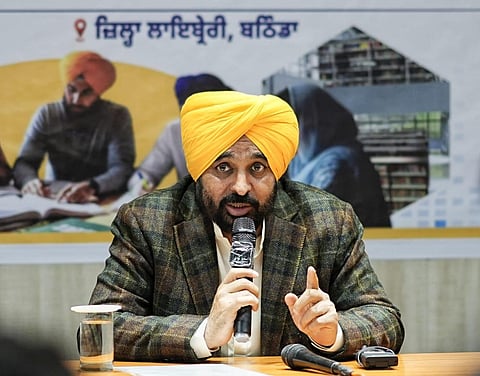

CHANDIGARH: In a major relief to farmers living along the border belt, Punjab Chief Minister Bhagwant Mann on Friday said the Union government is considering shifting the border security fence closer to the Indo-Pak International Border in the Punjab sector, which would allow unhindered cultivation of thousands of acres of farmland currently lying beyond the fence.
After meeting Union Home Minister Amit Shah in New Delhi, Mann told the media that farmers have for years been forced to cross the fence with identity cards and under BSF escort to reach their own fields, facing daily hardship and uncertainty along the 532-km India-Pakistan border where fencing lies deep inside Punjab’s territory. He said Shah informed him that the issue is under active consideration and that the fencing would be shifted closer to the border, bringing Punjab’s land back on the accessible side without compromising national security.
Mann said, “ Along the 532 km India Pakistan border, fencing is located deep inside Punjab’s territory. As per international norms, construction should be beyond 150 meters of the Zero Line, but in several areas of Punjab, the Border Security Fence is located two to three kilometers inside.”
The Punjab CM said thousands of acres of agricultural land lie beyond the fence, forcing farmers to show identity cards and cultivate their fields under BSF escort every day. “ If the fence is realigned closer to the International Border, large tracts of Indian land will come this side of the fence, allowing farmers to cultivate without fear and daily restrictions, without compromising national security."
Farmers have about 45,000 acres of land between the border fence on the Indian side and the zero line along the 530-km international border in the Punjab sector, spread across six border districts — Pathankot, Gurdaspur, Amritsar, Taran Taran, Ferozepur and Fazilka.
Mann also opposed the proposed Seed Act, 2026, which is likely to be tabled in the upcoming Budget Session of Parliament. He said he conveyed his concerns to the Centre, stating, “ After the Act comes into effect, the private companies will say we should buy seeds from them, while in Punjab, we have a tradition that we keep the seeds on the side to sow them for the future sowing season. The private companies cannot dictate to us,” adding that Shah assured him the issue would be taken up.
“ Punjab is an agrarian state and one of the largest grain producing states of the country, yet the draft Seed Bill does not assure representation of the state as per schedule under the relevant section. The zone based system introduced in the Bill does not guarantee Punjab’s representation in the Central Seed Committee, unlike the existing system, thereby limiting the state’s voice in decisions that directly affect the seed sector,” Mann said.
He added, “ The proposed Bill also curtails the existing powers of the State Seed Committee, as there is no role envisaged for the state level committee in seed registration, and the draft is silent on a robust compensation framework for farmers who suffer losses when registered seed fails to perform as claimed.”
Mann further warned that seed varieties tested and released in foreign countries are being allowed for import and sale in Punjab and other states without compulsory multi-location testing under state-specific agro-climatic conditions, posing serious risks to farmers. He said agriculture is Punjab’s lifeline, where farmers grow crops, sell part of the produce and retain seeds for the next season, and forcing them to depend entirely on companies for seeds is neither practical nor in farmers’ interest. He urged that the Bill should not be brought before Parliament in its present form and said Shah assured him that the concerns would be examined.
Highlighting problems related to foodgrain movement and storage, Mann said, “ For the last five months, FCI has been moving only about 4 to 5 Lakh Metric Tonnes of wheat and 5 to 6 LMT of rice from Punjab. Against 95 LMT of pending rice of Kharif Marketing Season 2025-26 to be delivered, only 20 LMT of storage space is currently available.”
He said that to ensure timely delivery of custom-milled rice of KMS 2025-26 and availability of space for wheat during RMS 2026-27 starting April 1, 2026, a minimum monthly movement of 20 LMT of foodgrains — 10 LMT each of wheat and rice — is required. He also urged the deployment of special trains to clear stocks, noting that Punjab contributes around 125 LMT of wheat to the national pool and that proper storage is essential for national food security.
On the issue of Arthia Commission, Mann said, “ The Arthia Commission has been frozen since the 2019-20 procurement season, contrary to the provisions of The Punjab Agriculture Produce and Marketing Act 1961, and is currently capped at ₹46 per quintal for wheat and ₹45.88 per quintal for paddy.”
He pointed out that the commission at silos has been reduced to half of that in regular mandis and that the committee constituted in January 2024 to revise the commission has not taken a decision so far. “ Arthias are not agents, they provide essential services, and they deserve their rightful share. Delay in revising the commission can disrupt the smooth procurement process, and the rates should be finalised at the earliest,” he said.
Mann also raised the issue of appointing a Punjab cadre officer as General Manager of FCI Punjab, saying officers from the state cadre have critical familiarity with procurement, mandis, storage and movement of foodgrains. He said that historically the post has been held by Punjab cadre officers, with others given only temporary charge, and urged that this convention be followed in the interest of efficiency and national food security.
