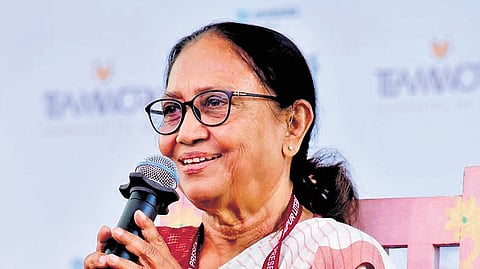

JAIPUR: Writing does not begin on the page. It begins in the body — in life experience, in memory, in pain, in hope. I wrote because something within me refused to accept that these lives were meant to remain invisible,” said International Booker Prize winner Banu Mushtaq during her keynote address, which marked the opening of the 19th edition of the Jaipur Literature Festival on January 15.
Mushtaq noted that her writing is shaped by an attempt to understand the world around her — much like many others who have lived in spaces marked by inequality, violence, and silence. Literature, she argued, resists power differently.
In a conversation with Moutushi Mukherjee, presented by The New Indian Express, Mushtaq spoke about Heartlamp, life after the Booker, and what lies ahead. The veteran Kannada writer, advocate, and activist recently won the International Booker Prize for Heartlamp, a collection of short stories translated from Kannada by writer Deepa Bhasthi.
Mushtaq shared an anecdote known to those following her journey—losing her entire baggage while in transit to London for the award ceremony. When she posted about it on Facebook, thousands responded — not with sympathy, but with a single message. “All of them said, forget about the luggage, madam, but please bring the Booker,” she recalled.
Despite the accolades, Mushtaq admitted that the past year has left her little space to write. Constant travel — between airports, road journeys, and public conversations — has made sustained creative work difficult. “At the most, I write one or two poems while waiting in an airport lounge.” Projects begun before the Booker, including her autobiography, remain paused midway. Completing it is now her first priority, followed by her seventh Kannada short story collection and a second English collection, both currently in progress.
The conversation also turned to what Heartlamp’s win means for writers working in India’s vernacular languages. “Younger writers have awakened,” she said, before adding, “or rather, more than the writers, their parents have awakened. They want to shape the younger generation as writers.”