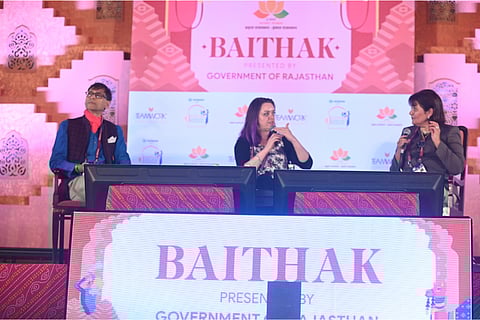

JAIPUR: An insightful session at the Jaipur Literature Festival 2026 brought together scholars to examine the sharply divergent ideologies and enduring legacies of Mahatma Gandhi, V D Savarkar and Muhammad Ali Jinnah, and how their competing visions shaped the destiny of undivided India and continue to influence political discourse today.
The session, held at the Baithak venue on Saturday evening, featured historian Alex von Tunzelmann, scholar Makarand Paranjape and author-playwright Kishwar Desai. The panel engaged in a wide-ranging discussion on ideological conflicts during India’s freedom struggle and the fraught process of nation-building.
In his opening remarks, Makarand Paranjape focused on the ideological clash between Gandhi and Savarkar. In the context of his new book ‘Hindutva and Hind Swaraj’, Paranjape elaborated on the Gandhi-Savarkar differences, which in his view reflected the larger clash between various factions within Hindu society. He specifically noted Savarkar's opposition to Gandhi's support for the Khilafat movement.
While acknowledging that Gandhi backed the movement to foster Hindu-Muslim unity, Paranjape said Savarkar viewed it as appeasement and had warned that such policies could eventually lead to Partition. He noted that Jinnah, too, had opposed the Khilafat movement, despite Gandhi’s intention of drawing Muslims into the national mainstream and transforming the freedom struggle into a mass movement.
Historian Alex von Tunzelmann, author of Indian Summer, analyzed the roles of Jinnah and Gandhi in the Partition of India and focussed on the global ramifications of their political choices. She stated that the partition of India was not merely a political event, but that the decisions taken behind it had global consequences. Tunzelmann compared Gandhi's moral politics and non-violence-based vision with Jinnah's initial constitutional thinking and his later communal politics focused on minority rights. She argued that ideological orientations and contrasting views of the two leaders permanently altered the future of the subcontinent.
Author and playwright Kishwar Desai who moderated the discussion cited the late economist/thinker Meghnad Desai's book "Mohan and Mohammed," in order to discuss some lesser-known events in the lives of Gandhi and Jinnah and their mutual conflicts. She asserted that the dialogue and ideological differences between the two leaders decisively shaped the course of Indian history. Sharing her experience of establishing the Partition Museum, Kishwar said that understanding the pain of Partition and learning from it is as important today as it was then.
The panel also discussed the significance of two seminal works published in 1909—Gandhi’s Hind Swaraj and Savarkar’s The Indian War of Independence. While both leaders were committed to India’s freedom, their methods differed radically: Gandhi emphasised truth, non-violence and self-restraint, while Savarkar advocated armed resistance. Their most fundamental divergence, the speakers noted, lay in their contrasting views on the Hindu-Muslim question.
The panellists agreed that the conflicting and sometimes clashing ideologies of Gandhi, Savarkar, and Jinnah have decisively shaped the India we know today. Without a thorough examination of these leaders' ideas and their historical context, neither the country's history nor current political debates can be fully understood.
