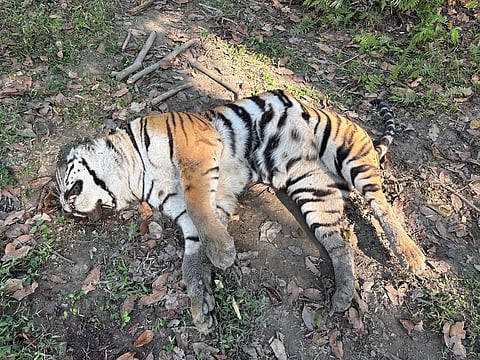

GUWAHATI: In the past 15 days, three Royal Bengal tigers died in Kaziranga National Park and Tiger Reserve (KNPTR) in Assam, due to suspected infighting.
In the latest of the incidents, the carcass of a female tiger was found on Sunday at around 4 pm.
“A committee was constituted by Director, KNPTR for carrying out post-mortem examination and disposal of carcass as per the SOP of National Tiger Conservation Authority,” a statement issued by the park authorities stated on Monday.
It added that preliminary findings during post-mortem suggested that infighting led to the tiger’s death.
On January 4, the carcass of another female tiger was found and officials stated that preliminary findings during post-mortem pointed to death caused by infighting.
Then on January 14, the carcass of a young male tiger was found at Thute Chapori of Eastern Range, Gamiri under the Biswanath Wildlife Division of Kaziranga Tiger Reserve.
During a preliminary examination, veterinary officers suspected that the death was either natural or due to infighting, officials stated.
The park has a tiger population of 148 tigers, according to 2024 estimates.
Addressing a crowd on Sunday after laying the foundation stone for the Rs 6,957 crore Kaziranga Elevated Corridor from Kaliabor, which is located 20-25 km from the south-western edge of the national park, Prime Minister Narendra Modi had described Kaziranga as Assam’s soul and a biodiversity jewel of the country.
He stated that the elevated corridor had been designed keeping in mind traditional movement routes of rhinos, elephants and tigers. He added that the government’s effort was to ensure smooth traffic while keeping the forest safe.
He recalled that there was a time when rhino poaching was a major concern but the BJP government strengthened security measures, provided modern resources to the forest department, enhanced surveillance and as a result, not a single incident of rhino poaching was reported last year.
Kaziranga, a UNESCO World Heritage Site which was declared a Tiger Reserve in 2006, is also home to large breeding populations of Indian elephant, wild water buffalo and swamp deer.
