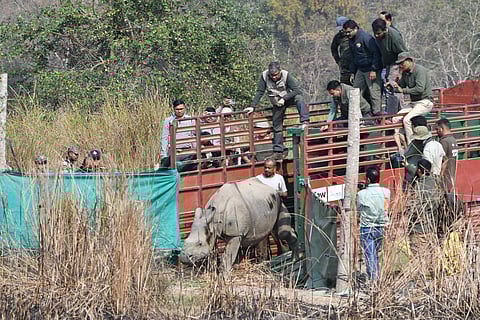

GUWAHATI: Two flood-rescued male rhino calves were on Tuesday translocated from the Centre for Wildlife Rehabilitation and Conservation (CWRC) to a pre-release enclosure at Kaziranga National Park in Assam, marking a crucial step towards their return to the wild.
The calves had been under intensive care at the CWRC for over four years. When rescued during floods, they were aged about four to six weeks.
According to the CWRC, the park authorities followed internationally accepted conservation translocation protocols. After obtaining the requisite permissions from the Chief Wildlife Warden, Assam, under the Wildlife (Protection) Act, a site selection committee was constituted to identify locations ideally suited for pre-release enclosures.
“Thereafter, the rhinos were moved to a pre-release enclosure, where they would be habituated to living under wild conditions before their final release to roam freely in the park,” the CWRC said.
Dr Bhaskar Choudhury, Centre-in-Charge, CWRC, told this newspaper that the calves would be released into the wild after about two months.
The translocation operation was overseen by a team of veterinarians. Kaziranga National Park officials, led by Field Director Dr Sonali Ghosh, along with subject matter experts Dr Rathin Barman, Kaushik Barua and Dr Anupam Sarmah, accompanied and supervised various aspects of the operation.
“This rhino transfer is a testimony to the scientific management and established rehabilitation protocols being followed in Kaziranga, where every wild animal, especially the iconic greater one-horned rhinoceros, is given a chance to return to its natural home in the wild, even after experiencing severe stress due to calamities such as floods,” the CWRC said.
The CWRC was established in 2002 as a collaborative initiative among Assam’s Forest Department, Wildlife Trust of India and the International Fund for Animal Welfare.
Its primary role involves rescuing flood-distressed and orphaned wild animals, especially in Kaziranga, providing emergency care, hand-raising them, and rehabilitating fit individuals back into the wild.
The CWRC has rescued and handled over 7,397 animals across 357 species to date, with approximately 4,490 (65 per cent) successfully released after treatment.