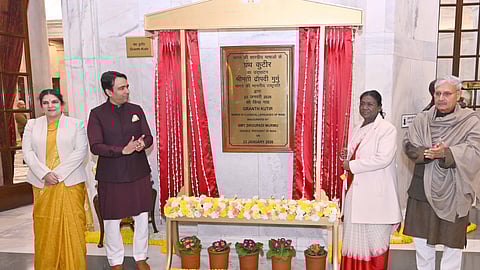

NEW DELHI: President of India Droupadi Murmu on Friday inaugurated the Granth Kutir at Rashtrapati Bhavan, a dedicated space that houses a rich collection of manuscripts and books in 11 classical languages of India. These include Tamil, Sanskrit, Kannada, Telugu, Malayalam, Odia, Marathi, Pali, Prakrit, Assamese and Bengali. The Granth Kutir highlights India’s vast and diverse cultural, philosophical, literary and intellectual heritage.
The Kutir holds a collection of around 2,300 books across these classical languages. On October 3, 2024, the Government of India conferred ‘Classical Language’ status on Marathi, Pali, Prakrit, Assamese and Bengali. Prior to this, six languages already enjoyed classical language status.
The collection spans a wide range of subjects, including epics, philosophy, linguistics, history, governance, science and devotional literature, and also includes the Constitution of India in these languages. Around 50 manuscripts form part of the collection, many of which are handwritten on traditional materials such as palm leaf, paper, bark and cloth.
The Granth Kutir has been developed through collaboration with the Central Government, State Governments, universities, research institutions, cultural organisations and individual donors from across the country. The Ministry of Education and the Ministry of Culture, along with their affiliated institutions, have supported the initiative. The Indira Gandhi National Centre for the Arts (IGNCA) is providing professional expertise in the management, conservation, documentation and display of manuscripts.
Earlier, books such as A Catalogue of the Original Works of William Hogarth, Speeches of Lord Curzon of Kedleston, Summary of the Administration of Lord Curzon of Kedleston, Life of Lord Curzon, Punch magazines and others were housed in this space. These have now been relocated to a separate area within the Rashtrapati Bhavan estate. As part of the archival collection, these books have been digitised and will be made available online for research scholars.
Visitors will be able to view selected works and manuscripts during the conducted tour of Rashtrapati Bhavan, Circuit 1. Information about the collection, along with access to books and manuscripts, will also be available through an online portal. Researchers may apply through the portal for physical access to the Granth Kutir.
According to an official statement, ancient works that contributed to the recognition of classical languages include the Vedas, Puranas and Upanishads in Sanskrit; Gathasaptasati, the earliest known Marathi literary work; the Vinaya Pitaka in Pali, which outlines monastic rules for Buddhist monks; Jain Agamas and Prakrit inscriptions that serve as vital historical records; Charyapadas, ancient Buddhist Tantric texts in Assamese, Bengali and Odia; Tirukkural, the classic Tamil treatise on ethics and life; the Mahabharata in Telugu; Kavirajamarga, the earliest available work on rhetoric, poetics and grammar in Kannada; and Ramacharitam in Malayalam.
Addressing the gathering, the President said that classical languages have provided the foundation of Indian culture. “Knowledge of science, yoga, Ayurveda and literature composed in India’s classical languages has guided the world for centuries. Texts such as the Tirukkural and Arthashastra remain relevant even today,” she said.
She further noted that disciplines such as mathematics, astronomy, Ayurveda and grammar developed through these languages. “Panini’s grammar, Aryabhata’s mathematics, and the medical science of Charaka and Sushruta continue to amaze the world even today. These classical languages have also made a significant contribution to the development of modern Indian languages,” she said.
Emphasising collective responsibility, the President said it was the duty of all conscientious citizens to preserve and promote the legacy of classical languages. She stressed the need to promote their study in universities, encourage young people to learn at least one classical language, and make more books available in libraries. The Granth Kutir, she added, is part of Rashtrapati Bhavan’s broader effort to preserve and promote India’s classical languages.