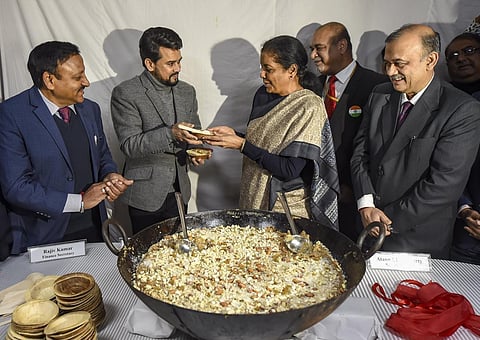

CHENNAI: Finance Minister Nirmala Sitharaman on Tuesday participated in the traditional ‘halwa’ ceremony, marking the final stage in the preparation of the Union Budget 2026–27, which is scheduled to be presented in the Lok Sabha on February 1. The ceremony, held at the North Block in New Delhi, formally signals the start of the “lock-in” period for officials and staff involved in drafting and printing the Budget documents.
The halwa ceremony is a long-standing tradition in India’s budget-making process and carries both symbolic and practical significance. At a symbolic level, the ritual represents the sweetening of the intense and complex exercise of preparing the Union Budget, one of the most important annual policy documents of the government. The distribution of halwa by the Finance Minister to officers and support staff is seen as a gesture of appreciation for their months of behind-the-scenes work.
In practical terms, the ceremony marks the point from which all personnel associated with the Budget are physically sequestered within the North Block premises until the Budget is presented in Parliament. This lock-in is designed to maintain strict confidentiality and prevent any leakage of sensitive fiscal information before the official announcement. In an era of digital workflows, secure networks and electronic document management, the tradition continues as a visible reminder of the importance attached to secrecy and integrity in the budgetary process.
Over the decades, the halwa ceremony has come to symbolise continuity in governance, linking present-day administrations with practices followed since the early years of independent India. Even as the Budget’s format, presentation style and policy priorities have evolved, the ritual has remained unchanged, reinforcing a sense of institutional memory within the finance ministry.
The ceremony also highlights the collective nature of Budget-making. While the Finance Minister presents the document and sets the overall policy direction, its preparation involves a wide range of officials, including economists, tax experts, expenditure managers, statisticians, printers and support staff. The halwa ceremony acknowledges this collaborative effort and underscores that the Budget is the product of an extensive administrative and technical exercise rather than a single individual’s work.
This year’s ceremony assumes added significance as the government prepares to unveil a Budget against a backdrop of global economic uncertainty, domestic growth aspirations and expectations of continued focus on infrastructure, manufacturing, employment and fiscal consolidation. With the lock-in now underway, attention will turn to February 1, when the government’s fiscal roadmap for 2026–27 will be laid out before Parliament and the country.
In essence, the halwa ceremony is more than a cultural ritual. It serves as a bridge between tradition and modern governance, reinforcing discipline, confidentiality and respect for institutional processes that underpin one of the most consequential exercises in India’s democratic system.