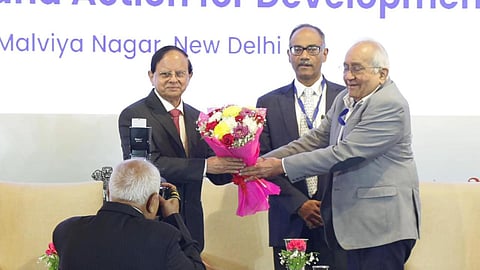

NEW DELHI: Dr P K Mishra, Principal Secretary to the Prime Minister Narendra Modi, while addressing the inaugural session of the International Conference on ‘Sustainable Energy Transition – Global Perspective’ on Thursday, emphasised that clean energy is deeply embedded in India’s vision of Viksit Bharat. He said it is no longer a sectoral agenda but central to growth, competitiveness, social inclusion and energy security.
Drawing inspiration from Prime Minister Narendra Modi’s words during India Energy Week last year, “A developed India will be built on clean energy, green growth, and sustainable lifestyles”, Dr Mishra said that India’s energy transition since 2014 offers two key lessons.
“Firstly, ambitious targets gain credibility only when supported by institutional architecture, sustained financial commitment, and consistent execution. India’s ability to achieve 50% of installed capacity for clean energy by 2025 instead of 2030, and 100 GW of solar capacity well ahead of earlier expectations, demonstrates the importance of policy continuity and institutional strength,” he said. He further added, “Secondly, energy transitions are most durable when they deliver tangible welfare gains.”
Dr Mishra noted that the impact of PM-KUSUM on farmers, PM Surya Ghar’s relief for households, and the jobs created through solar manufacturing and electric mobility demonstrate that decarbonisation and development can reinforce, rather than undermine, each other.
Focusing on energy security, affordability and universal access, he opined that for the Global South, the transition must be just, inclusive and development-aligned, recognising differentiated responsibilities, national circumstances and the need for sustained international cooperation.
Expressing optimism, Dr Mishra said that India has already reduced the emissions intensity of its GDP by about 36 per cent between 2005 and 2020 and became the first G20 country to meet its Paris Agreement commitments nine years ahead of the 2030 timeline. “It is against this backdrop that we must view India’s energy transition strategy,” he said.
Dr Mishra stressed that diversification of energy sources has contributed significantly to both decarbonisation and energy security. Referring to a range of government initiatives, he spoke about the acceleration of the National Solar Mission, with the solar target scaled up from 20 GW to 100 GW; amendments to the National Tariff Policy in 2016; the National Policy on Biofuels (2018); and the National Hydrogen Mission, announced by the Prime Minister on Independence Day 2021, which has signalled a shift towards green hydrogen to decarbonise the economy and reduce long-term fossil fuel imports.
He also underlined that India has undertaken a historic reform by opening nuclear energy to private participation through recent legislative initiatives. “This is expected to scale nuclear capacity significantly by 2047 and provide firm, zero-carbon baseload power,” he said, adding that taken together, these measures align the energy transition directly with energy security and import reduction, thereby enhancing India’s strategic autonomy.
Dr Mishra highlighted that PM-KUSUM exemplifies policy convergence, wherein the energy transition supports agricultural resilience, fiscal sustainability and rural development in a mutually reinforcing manner. He said the biofuels programme further deepens this rural transformation.
He stated that the benefits of clean energy extend directly to households, turning consumers into active participants and producers in the energy system. He noted that India has already achieved near-universal household electrification, ensuring that clean energy expansion coincides with social inclusion. “Building on this, the PM Surya Ghar Muft Bijli Yojana, launched in 2024, brings clean energy directly to rooftops. Together with building codes and efficiency standards, UJALA LED programme programmes make energy efficiency a cornerstone of India’s low-carbon development strategy,” he said.
Dr Mishra emphasised that the launch of the Lifestyle for Environment (LiFE) movement was a significant development, as it recognised the importance of behavioural change alongside technology from a sustainability perspective. With these measures, he said, India has become the first G20 country to meet its Paris targets well ahead of schedule and has now crossed 50 per cent non-fossil installed electricity capacity, again ahead of declared timelines.
Speaking on the Production Linked Incentive (PLI) scheme for solar PV modules, Dr Mishra stressed its importance in driving a decisive shift towards domestic manufacturing. Since 2022, solar module manufacturing capacity has expanded to around 120 GW, an increase of about 82 GW. “This is complemented by support for advanced battery manufacturing and other clean-energy supply chains,” he added.
Referring to the International Solar Alliance (ISA), he said it brings together 112 sun-rich nations, predominantly from the Global South, with India as a key convenor and knowledge partner. “India’s commitments under Panchamrit, its early achievement of Paris targets, and the launch of LiFE have strengthened its role as a global climate leader,” he said.
Dr Mishra also asserted that India has consistently argued for the recognition of differentiated responsibilities, enhanced climate finance and meaningful technology transfer.
Outlining emerging priorities, he emphasised that as renewable energy increases, system reliability and grid stability become more complex. “India has responded through greater investment in transmission, including HVDC corridors, and the scaling of storage solutions,” he said.
Dr Mishra noted that coal will continue to play a role in ensuring energy security in the near term. “India’s approach acknowledges this reality while steadily reducing emissions intensity and exploring options such as coal gasification and diversification of regional economies. Climate finance and technology access remain major constraints for the Global South,” he said, asserting that India has consistently maintained that climate action must be rooted in equity and climate justice.