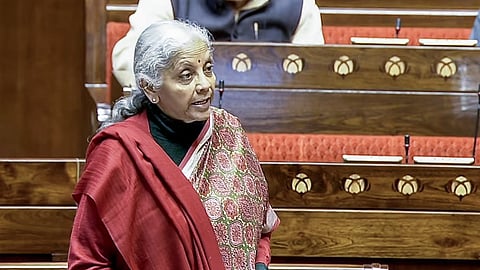
Union Finance Minister Nirmala Sitharaman tabled the Economic Survey 2025–26 in the Lok Sabha on Thursday, projecting FY27 GDP growth at 6.8–7.2%, with the Survey noting FY26’s fiscal deficit is on track at 4.4%.
The forecast marks a slowdown from the 7.4% growth estimated for FY26, which exceeded last year’s Economic Survey projection of 6.3–6.8%.
Chief Economic Adviser V Anantha Nageswaran said that India has the potential to achieve 7.5% GDP growth in FY27, driven by improved manufacturing and land reforms.
The rupee underperformed in 2025 amid drying foreign capital flows, though an undervalued currency offsets, to some extent, the impact of higher US tariffs, the survey noted.
Highlighting India’s 1.2 crore-strong gig workforce, the survey said roughly 40% earn under Rs 15,000 a month, recommending minimum per-hour or per-task wages, including compensation for waiting time, to narrow the gap with regular employment.
The survey also said the recently-inked EU FTA would boost manufacturing competitiveness, export resilience, and strategic capacity, while ongoing US trade talks are expected to conclude in this year.
Parliament proceedings were adjourned after the survey was tabled; the Lok Sabha will reconvene on February 1 for the presentation of the Union Budget 2026–27.
The Economic Survey on Thursday noted that all import substitution are not desirable, while stressing that though the concept of Swadeshi is inevitable, it is a disciplined strategy rather than a blanket doctrine.
The most persistent objection to Swadeshi-oriented policies is not ideological but empirical, it said.
"Not all import substitution is desirable, and not all forms of protection support long-term competitiveness," the survey said, adding import substitution is justified when domestic production is already feasible at reasonable cost but is impeded by non-economic factors such as coordination failures or legacy regulatory burdens.
These conditions differentiate intelligent import substitution (conditional protection) from indiscriminate sheltering of domestic incumbents, it said.
It also said that the next phase of industrialisation will require a calibrated shift from a model centred mainly on import substitution towards one focused on scale, competitiveness, innovation and deeper integration into global value chains (GVCs).
The Economic Survey stated that the government's welfare measures have significantly reduced poverty, with the bottom 5-10 per cent of the population registering the sharpest rise in consumption expenditure.
The survey highlighted positive outcomes from subsidies, pensions, direct benefit transfers and public spending on education and healthcare, which it said have lifted the vulnerable out of deprivation.
This is reflected in the latest Household Consumption Expenditure Survey (HCES) 2023-24, which shows a decline in consumption inequality and marked gains for the most disadvantaged groups. The largest growth in average monthly per capita expenditure (MPCE) between 2022-23 and 2023-24 was observed among the bottom 5-10 per cent in both rural and urban areas, the survey noted.
"The government's initiatives to lift the vulnerable out of the cycle of deprivation have yielded positive results, as reflected in various measures of poverty reduction," it said.
The Survey also called for amplifying rural economic momentum through local opportunities and innovation, while preserving the environment, culture and traditions to foster inclusive growth across rural India.
"Rural communities can learn new skills, find livelihoods, maintain health and financial stability, restore household harmony, access modern education while preserving cultural heritage, connections and respect for the Earth," it stated.
It emphasised sustaining social development through community engagement and continuous feedback, advocating frequent technology-enabled surveys for targeted, data-driven interventions.
Chief Economic Adviser V Anantha Nageswaran said on Thursday that India has the potential to achieve 7.5% GDP growth in FY27, driven by improved manufacturing and land reforms.
The remark follows the 2026 Economic Survey, which projected FY27 growth at 6.8–7.2%, marking a slowdown from the 7.4% estimated for the current financial year.
Nageswaran also cautioned that states must maintain fiscal discipline to keep sovereign borrowing costs in check.
His remark comes as the Economic Survey flagged concerns over fiscal populism, noting that rising cash transfers are crowding out capital expenditure. It further highlighted that revenue deficits in several states have increased in recent years, stressing that any fiscal indiscipline at the state level can push up sovereign borrowing costs and complicate macroeconomic management.
The Economic Survey 2025-26 has flagged digital addiction as a growing public health concern, affecting the mental health and productivity of youth and adults. Tabled in Parliament on Thursday, the Survey called for comprehensive interventions to address compulsive use of digital platforms, which can impair academic performance, workplace output, and psychological well-being.
It recommended that online platforms be held responsible for enforcing age verification and age-appropriate defaults, particularly for social media, gambling apps, auto-play features, and targeted advertising. Policies limiting access for younger users may also be considered, as they are especially vulnerable to compulsive behaviour and harmful content.
The Survey stressed the promotion of simpler, safer devices for children to access educational content, alongside initiatives to educate families. Parents are encouraged to enforce screen-time limits, device-free hours, and shared offline activities. Schools and community centres can conduct workshops to train guardians on setting healthy boundaries, recognising early signs of addiction, and using parental control tools effectively.
Citing evidence from the World Health Organization, the Survey highlighted “Gaming Disorder,” characterised by impaired control over gaming, prioritising gaming over other activities, and continuing despite negative consequences. Gaming disorder is linked to sleep disruption, social withdrawal, aggression, anxiety, and depression. Online gambling and real-money gaming are also associated with financial stress, depression, and suicidal ideation.
Obesity affecting all age groups, dietary reforms needed: Economic Survey
Obesity is rising at an alarming rate and has become a major public health challenge in India, the Economic Survey 2025-26 said, emphasising the need for better nutrition and dietary reforms.
The survey highlighted that unhealthy diets, sedentary lifestyles, increased consumption of ultra-processed foods (UPFs), and environmental factors are driving obesity across all age groups, raising the risk of non-communicable diseases (NCDs) such as diabetes, heart disease, and hypertension, affecting both urban and rural populations.
According to the 2019-21 National Family Health Survey (NFHS), 24% of women and 23% of men are overweight or obese. Among women aged 15–49, 6.4% are obese, while 4% of men are obese. Alarmingly, excess weight among children under five rose from 2.1% in 2015-16 to 3.4% in 2019-21, with over 3.3 crore children obese in 2020 and projections reaching 8.3 crore by 2035.
The Survey called for restrictions on marketing of infant and toddler milk and beverages, and recommended “front-of-pack nutrition labelling” for high-fat, sugar, and salt (HFSS) foods, particularly to protect children.
Noting obesity as a critical concern, the government has launched multi-pronged initiatives, including the National Programme for Prevention and Control of NCDs, under which over 31.5 crore adults have been screened, identifying 8.47 crore as overweight or obese. States have been asked to cut oil consumption by 10% and intensify public awareness efforts.
The Economic Survey on Thursday said inflation is unlikely to be a concern in the next fiscal year even though prices of precious metals -- both gold and silver -- are likely to continue to increase due to their sustained demand as safe-haven investments amid global uncertainties.
It said the inflation outlook remains benign, supported by favourable supplyside conditions and the gradual pass-through of GST rate rationalisation.
Looking ahead, the inflation outlook remains favourable, with projections of inflation staying within target ranges, supported by strong agricultural output, stable global commodity prices, and continued policy vigilance.
However, risks from currency fluctuations, base metal price surges and global uncertainties persist, warranting ongoing monitoring and adaptive policy responses.
"The prices of precious metals, both gold and silver, are likely to continue increasing due to their sustained demand as safe-haven investments amid global uncertainties, unless a durable peace is established and trade wars are resolved," the Survey said, adding that India's inflation rate -- headline and core excluding precious metals -- will likely be higher in FY27 than in FY26. However, it is unlikely to be a concern, it added.
The Survey said the RBI and the International Monetary Fund (IMF) have projected a progressive increase in headline inflation for the next fiscal year, bringing the levels within the targeted range of 4% (+/- 2%). The IMF has projected an inflation rate of 2.8% in FY26 and 4 per cent in FY'27. The RBI has forecast headline inflation for Q1 and Q2 of FY27 is 3.9% and 4% respectively.
Concerns over fiscal populism, the crowding out of capital expenditure by cash transfers and the rise of revenue deficits in states have increased in recent times, the Economic Survey said on Thursday as it stressed that any fiscal indiscipline at the state level casts a shadow on the sovereign borrowing costs.
"While the Centre has achieved consolidation alongside record public investment, rising revenue deficits and unconditional cash transfers in several States pose emerging risks by crowding out growth-enhancing spending," the pre-Budget document tabled in Parliament said.
Among other elements, it mentioned that Unconditional Cash Transfers (UCTs) have expanded rapidly across several states and now form a growing share of state-level welfare spending. Aggregate spending on UCT programmes, particularly for women, is estimated at around Rs 1.7 lakh crore for FY26.
With Indian government bonds now globally indexed and investors increasingly assessing general-government finances, the Survey said weak fiscal discipline at the state level can no longer be treated as locally contained; it increasingly affects the cost of sovereign borrowing.
"From a macro perspective, any fiscal indiscipline at the state-level also casts a shadow on the sovereign borrowing costs. With markets pricing government debt on a consolidated basis, persistent revenue deficits or an expansion of committed expenditures at the state-level could affect sovereign bond yields," the Survey said.
The government is well on track to meet the fiscal deficit target of 4.4% of GDP estimated for the current financial year based on broad trends, the Economic Survey 2025-26 tabled in Parliament on Thursday said.
According to the survey prepared by Chief Economic Advisor V Anantha Nageswaran and team, the central government's fiscal trajectory stands out for combining consolidation with sustained public investment, earning three sovereign rating upgrades this year.
Between FY20 and FY25 (Provisional Actual), the share of capital spending in the total central government expenditure increased from about 12.5% to 22.6%, while effective capex as a share of GDP rose from roughly 2.6% to 4%, the survey said.
Even as states are overshooting their revenue deficit, the central government, through its Special Assistance to States for Capital Expenditure/Investment (SASCI), has successfully incentivised states to maintain capital expenditure at around 2.4% of GDP, it said, adding the expansion of unconditional cash transfers across several states has contributed to rising revenue expenditure, with implications for fiscal space and public investment at the state level.
"Based on the broad trends observed during the year, the central government remains well on track to achieve its envisaged fiscal consolidation path, aiming to attain a fiscal deficit target of 4.4% of GDP in FY26," it said. As of November 2025, the Union government's fiscal deficit stood at 62.3% of the Budget Estimates, it said.
The global energy transition is increasingly constrained not just by technology but by control over critical minerals, with metals like copper, lithium, cobalt, nickel, and rare earth elements emerging as “strategic chokepoints” shaping low-carbon economies, energy security, and geopolitical influence, the Economic Survey 2025-26 said.
Supply disruptions in Indonesia, Congo, and Chile have made copper prices highly volatile, raising fears of medium- to long-term shortfalls amid surging demand from power grids and data centres. Export curbs by key supplier nations amplify these pressures.
Advanced economies are responding by promoting standards-based critical mineral markets, emphasising sustainability, traceability, and governance through initiatives such as the G7 Roadmap.
However, compliance costs — digital traceability, certification, and ESG requirements — can be steep, potentially limiting developing countries’ supply, locking them into low-value segments, and raising affordability challenges for global transitions.
The Survey stressed that a durable global framework must be inclusive, capacity-sensitive, and development-oriented, treating resource-rich regions as co-producers of value rather than raw material suppliers. International cooperation on technology transfer, skills, institutions, and investment is essential.
India’s strategy balances strategic autonomy with global integration through the National Critical Mineral Mission and international partnerships like the Minerals Security Partnership and Indo-Pacific Economic Framework, building domestic capabilities while engaging with the global market.
India’s relatively late entry into Artificial Intelligence offers an “underappreciated advantage,” allowing it to avoid the energy-intensive and financially risky paths taken by early adopters, and instead pursue a resource-efficient, inclusive AI trajectory aligned with public objectives, the Economic Survey 2025-26 said.
A dedicated chapter on the ‘Evolution of the AI Ecosystem in India’ highlights the technology’s transformational significance. The Survey stressed that regulation, data governance, and safety cannot be deferred, and must evolve alongside deployment.
“Early adopters who scaled AI under conditions of a regulatory vacuum and cheap capital have locked themselves into energy-intensive architectures and unclear financial commitments. India, by contrast, can avoid such dependencies,” it noted.
The Survey argued that India’s comparative advantage lies not in replicating frontier-scale models, but in application-led innovation, productive use of domestic data, human capital, and coordinated public efforts. A bottom-up strategy using sector-specific models, interoperable systems, and shared infrastructure offers a more credible path to value creation than scale alone.
The choices made now will determine whether AI deepens structural divides or supports broad-based productivity and dignified work. With deliberate policy and timely action, India can leverage its late-mover advantage to build a resilient, inclusive, and development-aligned AI ecosystem.
Stating that about 40% of gig workers in India earn below Rs 15,000 per month, the Economic Survey 2025-26 called for major policy interventions to ensure fair wages and reduce the gap with regular employment. The survey suggested setting minimum per-hour or per-task earnings, including compensation for waiting time.
Tabled in Parliament on Thursday, it said gig-economy policies should allow workers genuine choice, rather than forcing them into gigs due to weak demand, skill mismatches, or lack of a safety net. While the sector is expanding rapidly, income volatility and limited access to credit remain key challenges, with many workers reliant on “thin-file” loans.
The survey highlighted concerns over platform algorithms that govern work allocation, wages, and performance monitoring, raising issues of bias, burnout, and worker protection. “Platforms have become essential gig-market infrastructure… This concentration of power raises concerns over fees, algorithms, and worker protections,” it noted, urging competition rules, algorithmic transparency, and co-investment in tools and training to help workers move to higher-skilled gigs.
India’s gig workforce rose 55% to 1.2 crore in FY25, accounting for over 2% of total employment. Non-agricultural gig jobs are forecast to reach 6.7% of the workforce by 2029-30, contributing Rs 2.35 lakh crore to GDP.
Effective implementation of the Labour Codes will play a key role in supporting formal employment and improving security for women and gig workers, the Economic Survey 2025–26 said.
The survey, tabled in Parliament on Thursday, noted that all four labour codes were notified on November 21, 2025, with rules expected to be operational in the coming months. Draft rules under the Code on Wages, Industrial Relations Code, Code on Social Security and the Occupational Safety, Health and Working Conditions Code were pre-published on December 31, 2025, for stakeholder feedback.
India has seen strong employment growth in recent years, aided by structural reforms, tax rationalisation and sustained investment in skilling, the survey said. However, demographic shifts, technological change and the expansion of gig and platform work are reshaping the employment landscape, requiring dynamic labour policies and flexible regulatory frameworks.
The survey emphasised targeted skilling for women and youth in high-productivity sectors, along with flexible vocational pathways starting at the school level. It called for institutional convergence and a whole-of-government approach to align skilling and employment initiatives.
An integrated digital public infrastructure linking e-Shram, the National Career Service portal and training platforms could strengthen industry-driven skilling and improve job matching, it said.
As of January 2026, over 31 crore unorganised workers had registered on the e-Shram portal, with women accounting for 54 per cent, significantly expanding the reach of social security coverage, the survey added.
Climate action is no longer an environmental add-on but a core pillar of India’s development strategy, and with the global north dithering on its commitments, India must ensure that development gains are not lost, the Economic Survey 2025–26 said.
India has not yet reached peak energy demand, and ensuring energy access, affordability and security remains central to its development pathway. However, raising climate ambition, especially on mitigation, without corresponding support in finance and technology is neither realistic nor equitable, the survey tabled in the Lok Sabha said.
With India aiming to become a developed nation by 2047, the survey said this would require high, inclusive and environmentally sustainable growth, necessitating changes in consumption and production patterns alongside technological and policy reforms.
Although India’s per capita emissions remain well below the global average, climate change poses risks to livelihoods, infrastructure and economic stability. “Adaptation is, therefore, central to India’s climate strategy,” the survey said, driven primarily by public investment, state-led planning and community institutions.
India is pursuing a balanced mitigation pathway by scaling up renewables, battery storage and nuclear energy to meet energy security and industrial competitiveness goals.
However, inadequate global capital flows to developing countries remain a major constraint, underlining the need to reform multilateral financial institutions and strengthen domestic financial systems.
The survey criticised developed nations for limited ambition in their 2035 climate targets, saying many were backpedalling on Paris Agreement commitments despite having peaked emissions decades ago. Climate finance commitments to developing countries also remain diluted. These signals from the global north warrant placing adaptation at the centre of India’s climate action to protect development gains, it added.
Raising concerns over the growing consumption of ultra-processed foods (UPFs) high in fat and sugar, the Economic Survey has called for exploring a ban on their advertisements from morning to late night, along with restrictions on marketing infant and toddler milk and beverages.
The Survey proposed front-of-pack nutrition labelling with warning signs for high-fat, sugar and salt (HFSS) foods, curbs on marketing to children, and safeguards to ensure trade agreements do not undermine public health policy.
India is among the fastest-growing markets for UPFs, popularly known as junk foods such as burgers, noodles, pizza and soft drinks, a trend the Survey said is contributing to chronic diseases and widening health inequalities.
UPF consumption rose over 150 per cent between 2009 and 2023, while retail sales surged from USD 0.9 billion in 2006 to nearly USD 38 billion in 2019. “It is during the same period that obesity has nearly doubled in both men and women,” the Survey said.
It stressed that improving diets cannot rely solely on consumer behaviour change and will require coordinated policies across food systems, including regulation of UPF production and marketing.
“The option of a marketing ban on UPFs from 0600 hours to 2300 hours for all media… could be explored,” it said, citing examples from Chile, Norway and the UK.
It also flagged regulatory gaps, noting that existing advertising rules lack clear nutrient-based thresholds, allowing vague health claims to persist.
India’s agriculture sector, critical to achieving the government’s vision of a developed nation by 2047, faces significant sustainability and productivity challenges despite recent growth, the Economic Survey said.
Agriculture and allied activities contribute nearly one-fifth of national income but employ about 46.1% of the workforce, making the sector central to India’s growth trajectory.
The sector recorded an average annual growth of around 4.4% over the past five years at constant prices, led by gains in livestock and fisheries. In the second quarter of FY26, agricultural growth stood at 3.5%.
“Agriculture will be central to achieving Viksit Bharat, driving inclusive growth and improving the livelihoods of millions,” the survey tabled in Parliament said. However, it warned that climate change, erratic weather, rising temperatures and water scarcity — especially in monsoon-dependent regions — pose mounting risks to crop yields.
While India’s agricultural growth exceeds the global average of 2.9%, productivity remains uneven, with yields of cereals, pulses, maize and soybeans lagging global benchmarks. Irrigation coverage has expanded to 55.8% of cropped area, but disparities persist across crops and states.
The survey called for reforms including fertiliser rationalisation, higher R&D spending, improved irrigation, crop diversification and climate-resilient technologies. It also stressed strengthening farmer-producer organisations, markets, logistics and private investment to raise farm incomes and competitiveness.
India’s pharmaceutical industry is shifting from a volume-driven to a value-driven growth model, with greater emphasis on complex generics, biosimilars and innovation, the Economic Survey 2025–26 said.
The sector is the world’s third-largest by volume, meeting around 20% of global generics demand and exporting to 191 countries in FY25. Annual turnover stood at Rs 4.72 lakh crore in FY25, with exports growing at a compound annual growth rate of 7% over the past decade, the survey noted.
More than half of India’s pharmaceutical exports are directed to highly regulated markets such as the US and Europe. By value, India ranks 11th globally in pharmaceutical exports, with a 3% share. Medical devices exports have also expanded, rising from $2.5 billion in FY21 to $4.1 billion in FY25, though the survey flagged significant scope for further growth.
To move up the value chain, the industry is increasingly focusing on complex generics, biosimilars and innovation.
The survey said scaling up the medical devices sector will require reducing import dependence through advanced manufacturing technologies such as artificial intelligence and 3D printing, along with streamlined global certification processes.
Beyond generics, India remains a global leader in low-cost vaccine supply and is emerging as a competitive producer of high-end medical equipment, including MRI and CT scanners, cardiac stents and ventilators.
The domestic steel sector faces challenges linked to international price disparity and raw material security, the Economic Survey said on Thursday.
Describing steel as the backbone of industrialisation and infrastructure, the survey said the sector has helped secure India’s position as the world’s second-largest crude steel producer.
It noted that the industry has undergone a major transformation over the past five years, driven largely by strong domestic demand from the construction and manufacturing sectors.
“However, the sector faces challenges related to international price disparity and raw material security. India was also a net importer of steel during FY26 (April–October), primarily due to low international prices, which resulted in lower margins on exports and cheaper imports,” the survey stated.
While India is largely self-sufficient in iron ore, the industry remains critically dependent on imported coking coal. To mitigate global supply risks, the Ministry of Coal launched Mission Coking Coal in 2022, aiming to raise domestic raw coking coal production to 140 million tonnes by 2030.
A production-linked incentive (PLI) scheme for specialty steel, with an outlay of Rs 6,322 crore, was introduced in 2021 to sustain growth and promote self-reliance. As of October 2025, cumulative investment under the scheme stood at Rs 23,022 crore, with specialty steel production reaching 2.34 million tonnes. During April–October 2025–26, crude steel production rose 11.7%, finished steel output increased 10.8%, and consumption grew 7.8% year-on-year.
Rising automobile exports reflect the growing acceptance of India-manufactured vehicles across global markets, according to the Economic Survey 2025–26.
The automobile industry has seen strong export growth, with more than 5.3 million vehicles shipped across passenger, commercial, two-wheeler and three-wheeler segments in FY25, alongside double-digit growth in the first half of 2025–26, the survey noted.
A robust recovery in demand has driven both production and sales growth in the post-pandemic period. Overall, the industry recorded nearly 33% growth in production over the past decade, from FY15 to FY25.
Supported by a vast manufacturing and auto component ecosystem, the automobile sector provides direct and indirect employment to over 30 million people and accounts for nearly 15% of the country’s GST collections.
The survey described the automotive industry as a key driver of economic growth, with India established as the world’s largest market for two-wheelers and three-wheelers, and the third-largest globally for passenger and commercial vehicles.
Government initiatives, including production-linked incentive schemes for automobiles, auto components and advanced chemistry cell battery storage, along with the PM E-DRIVE and PM e-Bus Sewa schemes, have boosted electric vehicle registrations.
The Scheme to Promote Manufacturing of Electric Passenger Cars in India, notified in March 2024, has also supported sectoral growth.
The Rajya Sabha was adjourned for the day after tabling of the Economic Survey 2025-26 by Union Finance Minister Nirmala Sitharaman on Thursday.
The Economic Survey is an annual review of the country's economy. It is presented by the government ahead of the Union Budget. The Union Budget for 2026-27 will be presented by the Finance Minister on Sunday.
Sitharaman tabled a copy (in English and Hindi) of the Economic Survey, 2025-26, along with a statistical appendix in the Upper House. Soon after, Rajya Sabha chairman CP Radhakrishnan adjourned the House for the day.
Ongoing negotiations for a trade agreement with the US are expected to conclude during the year, a development that could help reduce uncertainty on the external front, according to Economic Survey 2025-26.
For India, it said, the global conditions translate into external uncertainties rather than immediate macroeconomic stress.
Slower growth in key trading partners, tariff-induced disruptions to trade and volatility in capital flows could intermittently weigh on exports and investor sentiment, the Survey said.
"At the same time, ongoing trade negotiations with the United States are expected to conclude during the year, which could help reduce uncertainty on the external front," it said.
India and the US are negotiating a bilateral trade agreement since March last year. So far, six rounds of negotiations have been held.
Talks are going slow as the Trump-administration has imposed a steep 50 per cent tariffs on Indian goods from August last year.
India’s Economic Survey for 2025-26 painted a cautiously optimistic picture, projecting GDP growth of 6.8–7.2% in 2026–27.
The government is prioritising steady, investment-led expansion over short-term stimulus, backed by strong domestic demand, rising public capital expenditure, and improving private investment sentiment.
Macroeconomic stability has largely returned after global shocks, with inflation moderating and fiscal consolidation on track.
Public investment in infrastructure — including roads, railways, ports, power, and urban development — is expected to crowd in private investment and boost job creation.
Private consumption remains resilient, supported by rising incomes and formal employment, while manufacturing is set to play a bigger role through incentives, ease-of-doing-business reforms, and deeper integration into global value chains.
Services, particularly IT, finance, tourism, and professional services, continue to drive growth and foreign exchange earnings.
The survey highlighted labour market improvements, stressing skilling, reskilling, and upskilling to meet evolving economic demands.
On the external front, India’s foreign exchange reserves remain comfortable, with a manageable current account deficit supported by strong services exports and remittances, even as merchandise trade faces global headwinds.
GDP growth for 2026–27 is projected at 6.8–7.2%
Rupee was a casualty of drying foreign capital flows and underperformed in 2025
Free trade agreement with Europe will strengthen India’s manufacturing competitiveness, export resilience, and strategic capacity
India needs to prioritise domestic growth amid an uncertain global environment, with greater emphasis on buffers and liquidity.
Realising the potential of trade agreements requires India to produce competitively, the survey notes, referring to a string of FTAs signed
GST rejig and reforms have turned global uncertainty into opportunity, while 2026–27 is expected to be a year of adjustment as the economy adapts to these changes
Correction in overly optimistic asset valuations will happen if AI boom fails to deliver the anticipated productivity gains
Ongoing negotiations for a trade agreement with US is expected to conclude during the year, a development that could help reduce uncertainty on the external front
Does not hurt to have an undervalued rupee as it offsets, to some extent, impact of higher US tariffs on Indian goods
India’s Economic Survey for 2025–26 projects GDP growth of between 6.8% and 7.2%, supported by strong macroeconomic fundamentals and a series of regulatory reforms.
The forecast marks a slowdown from the 7.4% growth projected for the current financial year. The government had projected growth of 7.4% for the current fiscal year, exceeding last year’s Economic Survey forecast range of 6.3% to 6.8%.
"The outlook, therefore, is one of steady growth amid global uncertainty, requiring caution, but not pessimism," said the pre-Budget document tabled in the Lok Sabha.
The rupee was a casualty of drying foreign capital flows and underperformed in 2025, the Economic Survey said.
Lok Sabha proceedings were adjourned for the day after Union Finance Minister Nirmala Sitharaman tabled the Economic Survey 2025–26. The House will reconvene on February 1, when the finance minister presents the Union Budget for the 2026–27 financial year.
Union Finance Minister Nirmala Sitharaman presented the Economic Survey 2025-26 in the Lok Sabha on Thursday.
The Economic Survey is an annual document presented by the government ahead of the Union Budget to review the state of the country's economy. It also provides an overview of the economy's short-to-medium-term prospects.
The Economic Survey is prepared by the Economic Division of the Department of Economic Affairs in the Ministry of Finance under the supervision of the chief economic adviser.
The first Economic Survey was presented in 1950-51. At that time, it used to be a part of the budget documents. In the 1960s, it was separated from the Union Budget and tabled ahead of the Budget presentation.
The Union Budget for 2026-27 will be presented by the finance minister on Sunday. This will be the ninth consecutive budget to be presented by Sitharaman, a historic first by a woman finance minister in India.
The Congress hit out at Prime Minister Narendra Modi over his remarks on the Budget session, saying he delivers his "usual hypocrisy-laden message to the nation" before the beginning of each session and "today's performance is part of this series."
Congress general secretary in-charge Jairam Ramesh said, "He (PM) will not convene and chair all-party meetings to take the opposition into confidence on national issues."
He will suddenly have Bills introduced at the last minute and bulldozed through Parliament without the necessary legislative scrutiny, Ramesh claimed, adding that Modi would not sit in Parliament and respond to the concerns of opposition leaders, and will instead make election rally speeches in both Houses.
"Before the beginning of each session, he will give his usual hypocrisy-laden 'desh ke naam sandesh' with Parliament as his backdrop. Today's performance is part of this series," the senior Congress leader said.
Prime Minister Narendra Modi said the country had boarded the “Reform Express” and is coming out of long-term pending problems and working towards long-term solutions. An India full of confidence has emerged as a ray of hope for the world, he added.
"This government has been identified with reform, perform, and transform. And now we have boarded the reform express... The country is now moving beyond long-term pending problems and is firmly stepping onto the path of long-term solutions," Modi said, speaking outside Parliament House.
The time has come to find solutions and not create hurdles, he said, adding his government is not confined to just files but ensuring the last-mile delivery of welfare schemes to the people.
"Our priority is always human-centric while taking steps for all-round development of the country," he told reporters in Parliament House complex in his customary briefing at the beginning of the Budget session.
Prime Minister Narendra Modi on Thursday said the free trade pact with the European Union is for an ambitious India and urged manufacturers to benefit from new markets opening for them.
"At the very beginning of this quarter, the India–European Union Free Trade Agreement reflects how bright the coming direction is and how promising the future of India's youth is. This is free trade for an ambitious India, for aspirational youth, and for a self-reliant India. I am confident that Indian manufacturers, in particular, will use this opportunity to enhance their capabilities," Modi said, speaking outside Parliament House.
Ahead of Day 2 of the Budget Session, Prime Minister Narendra Modi hailed Wednesday’s President’s Address as an expression of the trust of 140 crore Indians.
“The President’s Address yesterday was the expression of the trust of 140 crore Indians, an account of their capability and of the sketch of their aspirations, especially of the youth. For all MPs, the President also said several things to guide them. At the beginning of the session and 2026, the expectations expressed by the President. I am confident that all MPs took this seriously,” Modi said, speaking outside Parliament House.
Union Finance Minister Nirmala Sitharaman is set to table the Economic Survey 2025-26 in the Lok Sabha on Thursday.
The Economic Survey document, prepared by the Economic Division of the Department of Economic Affairs in the Ministry of Finance and formulated under the supervision of the chief economic adviser, provides insights into the state of the economy and various indicators for 2025-26 (April-March), as well as an outlook for the next fiscal.
Further, Union Minister of State for Civil Aviation Murlidhar Mohol will table documents related to the Airports Economic Regulatory Authority of India (AERA). In addition, a statement reviewing the working of the Airports Economic Regulatory Authority of India, New Delhi, for the year 2024-25 will be presented before the House.
As per the agenda, the House will first take up Question Hour, with questions listed separately to be asked and answered by the concerned Ministers. This will be followed by the laying of papers on the Table by members of the Union Council of Ministers.
A key item on the day's agenda is the formal laying of eight Bills that have been passed by both Houses of Parliament during the Sixth Session of the 18th Lok Sabha and have subsequently received the President's assent. The Bills will be laid on the table by the Secretary General of the Lok Sabha.
The House will also witness the presentation of the 13th Report of the Business Advisory Committee. The report will be presented by Kiren Rijiju and Kodikunnil Suresh, as listed in the agenda.
Additionally, the Lok Sabha will take up Matters under Rule 377, a parliamentary provision that allows Members of Parliament to raise issues of urgent public importance.
The Budget Session of Parliament commenced a day earlier.
The Budget Session will span 30 sittings over 65 days, concluding on April 2, with a recess from February 13 to March 9 for scrutiny of Demands for Grants by Standing Committees.
The second day of the 2026 Budget Session will see Union Finance Minister Nirmala Sitharaman table the Economic Survey in the Lok Sabha, offering an assessment of the economy and key indicators for 2025–26, along with an outlook for the next financial year.
Meanwhile, Minister of State for Civil Aviation Murlidhar Mohol will table documents related to the Airports Economic Regulatory Authority of India (AERA). A statement reviewing the functioning of AERA for 2024–25 will also be presented to the House.
A key item on the agenda is the formal laying of eight Bills passed by both Houses during the Sixth Session of the 18th Lok Sabha and subsequently assented to by the President. The Bills will be laid on the table by the Secretary General of the Lok Sabha.
The Lower House will also see the presentation of the 13th Report of the Business Advisory Committee by Union Minister Kiren Rijiju and Congress MP K Suresh, as listed in the agenda.

